An Education That Began at Home
For many American children growing up in the early 1940s, kindergarten was their first introduction to organized education. For others, learning had already begun at home with a parent who believed children could develop academic skills before entering a classroom.
That was the case in the Maier household in Woodside, Queens, New York.
Mildred Elizabeth St. Aubin Maier began teaching her young son, Ernest, when he was probably three or four years old. Although his precise age is difficult to establish more than eighty years later, he clearly remembers the teaching equipment and the attention his mother devoted to those early lessons.
One of the most memorable items was a wooden, two-sided easel. One side had a slate blackboard. The other apparently held large sheets of paper, perhaps from a roll. His mother would write something on the blackboard, and he was expected to copy it or complete an exercise she had prepared.
The details of individual lessons have faded, but the essential memory remains: his mother was giving him individual instruction in reading, writing, and arithmetic before he entered kindergarten.
Wooden blackboard easels were commercially available during the 1930s and 1940s. Some combined slate writing surfaces with paper or other instructional materials. In the Maier home, the easel served as more than a toy. It was a practical tool his mother used to teach him.
Kindergarten: A Different Experience
When Ernest entered kindergarten at Public School 178 in Woodside, he encountered a noticeably different educational environment.
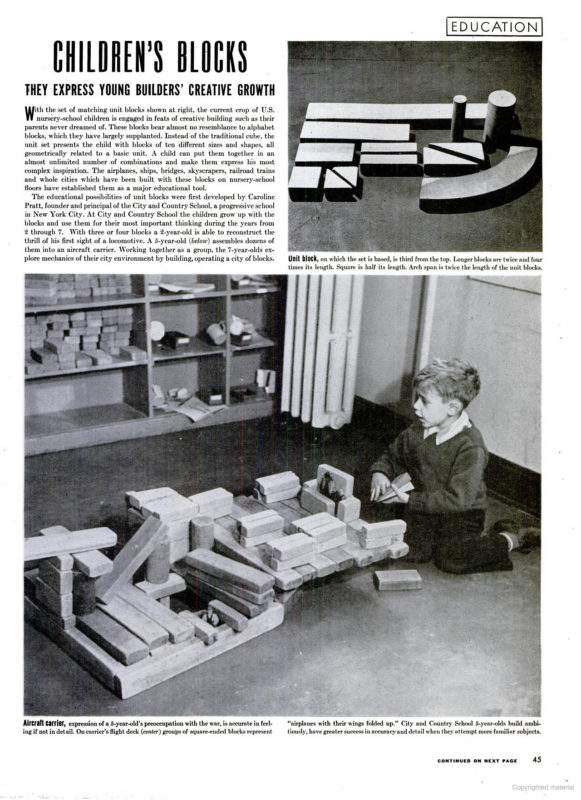
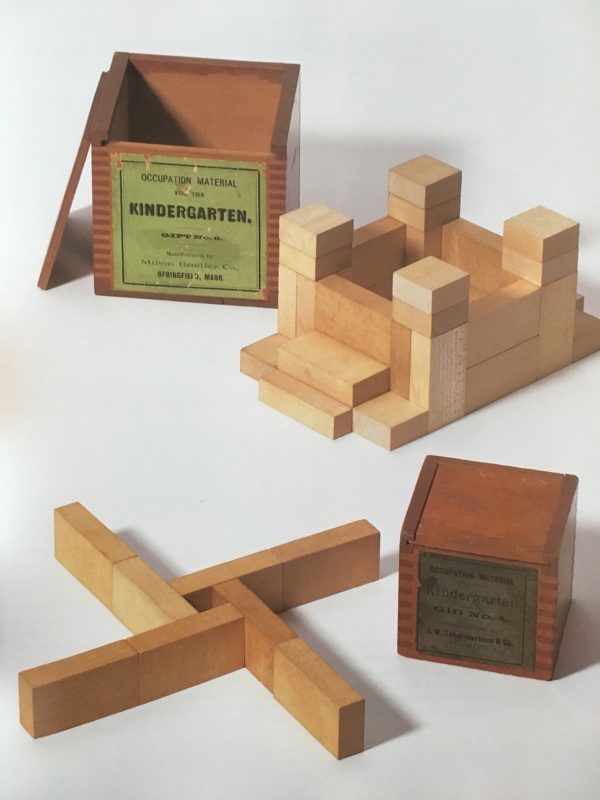
One of his clearest memories is a large box of wooden building blocks kept in a corner of the classroom. These were substantial pieces of wood in various shapes and sizes, neither tiny toys nor pieces of construction lumber. The children could use them to build whatever their imaginations suggested.
More than eight decades later, those blocks remain one of his strongest memories of kindergarten.
Their appearance suggests that they may have been the type known as unit blocks, developed by educator Caroline Pratt during the early twentieth century. Made in carefully related dimensions, these blocks became widely used in progressive nursery schools and kindergartens.
A standard rectangular unit block measures approximately 5½ inches long, 2¾ inches wide, and 1⅜ inches thick. Other blocks come in coordinated sizes and shapes.
Those dimensions closely match the blocks Ernest remembers. When shown pictures of Caroline Pratt’s unit blocks, he immediately recognized them as the same kind he had used in kindergarten. Although the manufacturer of the blocks at P.S. 178 has not been established, their appearance a nd dimensions are consistent with his recollections.
Two Approaches to Early Education
The contrast between Ernest’s lessons at home and his kindergarten experience raises a lasting question about early education: How can schools meet the needs of children who arrive with different levels of preparation?
At home, his mother emphasized traditional academic instruction. She prepared lessons, demonstrated what she wanted him to do, and expected him to follow her example.
In kindergarten, he encountered an approach that emphasized play, imagination, and group activities. Educators who promoted building blocks viewed them as learning tools. Through construction, children could explore shapes, solve problems, experiment, and learn to work with one another.
Both approaches offered opportunities to learn. Even so, a child who had already begun reading, writing, and arithmetic at home might find some classroom activities less challenging than the individual lessons he had previously received.
Looking back, Ernest wonders whether some of his early enthusiasm for formal learning diminished when he entered a classroom with a more standardized routine. This is a retrospective impression rather than a conclusion he can establish with certainty.
He does not remember enough of the daily schedule to say precisely how the teacher divided her attention. His impression is that activities such as block building may have kept some children occupied while the teacher worked with others. That would have been a practical way to manage a classroom in which children arrived with different skills and needs.
A child who does not yet know the alphabet needs different instruction from one who has already spent a year or two receiving individual lessons at home. Yet both may enter the same classroom and participate in many of the same activities.
Ernest’s recollections illustrate the challenge of combining meaningful educational play with appropriate academic instruction and individual attention. That challenge was present in the early 1940s, just as it is today.
A Mother Who Became a Teacher
Mildred Maier’s interest in teaching continued after her own children entered school.
Later in life, although she had never earned a college degree, she became a teacher at St. Matthew’s Catholic elementary school in Detroit. She taught second grade, prepared children for their First Holy Communion, and introduced them to cursive handwriting.
Her handwriting was particularly beautiful, and she passed that skill along to her students. Preparing children for First Holy Communion was another important responsibility, involving religious instruction and an understanding of the sacrament’s significance.
Her work extended over several years, becoming a second career in education.
The school’s willingness to entrust her with these responsibilities, despite her lack of a college degree, suggests the value it placed on her practical teaching ability and personal qualities.
In retrospect, the wooden easel in the Maier home was an early expression of an interest in education that eventually reached well beyond her own family.
The Easel Then and Now
The wooden easel remains familiar in early childhood education, although its design and materials have changed.
Modern classroom easels may be freestanding, adjustable, and designed for several purposes. One side may hold a dry-erase board, while another supports large sheets of paper. Some include magnetic surfaces for letters or other teaching materials. Smaller models allow children to work directly at the board, while larger ones give teachers a visible surface for group instruction.
The basic purpose remains familiar: an easel provides a place to write, draw, demonstrate, and share ideas. Its materials may have changed, but its usefulness as a teaching and learning surface has endured.
Wooden building blocks also remain part of many early childhood classrooms, although their availability varies. Today, they may appear alongside plastic construction sets, magnetic tiles, digital tools, and other educational materials.
Ernest’s experience in higher education offers another point of comparison. University instruction often uses computers, projectors, interactive displays, and specialized laboratory or studio equipment. A traditional classroom easel was never part of his own teaching at that level, although easels continue to serve particular purposes in fields such as art.
For Ernest, the wooden teaching easel remains closely associated with early childhood: a place where a parent or teacher could make a lesson visible and invite a child to take part.
Looking Back More Than Eighty Years
Childhood memories are selective. Some experiences disappear almost entirely, while seemingly ordinary objects remain vivid throughout a lifetime.
For Ernest, two such objects stand out: a wooden easel with a slate blackboard and a box of carefully shaped wooden building blocks.
One recalls his mother’s individual attention and academic lessons at home. The other recalls a classroom approach that encouraged activity, construction, and imagination.
Both had value. Together, they also raise questions about how schools recognize children’s existing abilities and provide opportunities for each child to keep learning.
Perhaps the most enduring part of this memory, however, is the woman who stood beside the easel.
Long before she became a second-grade teacher, Mildred Elizabeth St. Aubin Maier was already teaching in her own home. With a simple wooden easel and the materials available to her, she gave her young son an early start in education.
More than eighty years later, her lessons, the kindergarten building blocks, and the differences between those experiences remain a vivid part of Ernest’s memories of growing up in America during the early 1940s.