My Business Failures
Over the years, I started several businesses while I was teaching at Lawrence Technological University. Some were successful, and some weren't.
My aquatic weed-control company, Aqua Weed Control, turned out to be a great success. That business was operated by my wife, Jean, and me, without any partners. After decades of success with this business, employing many family members and neigbors, we sold this business to our daughter and her husband. It continued to be successful int their hands and is has now been passed onto a third generation of owners and continues to be very succesfully owned and operated.
But I also started two other businesses that didn't work out nearly as well. Both involved partners, and both taught me something about the difficulties of running a business when I had too many other things on my mind. Here are the stories of those two ventures.
Failure No. 1: K & M Leisure Sales, Inc.
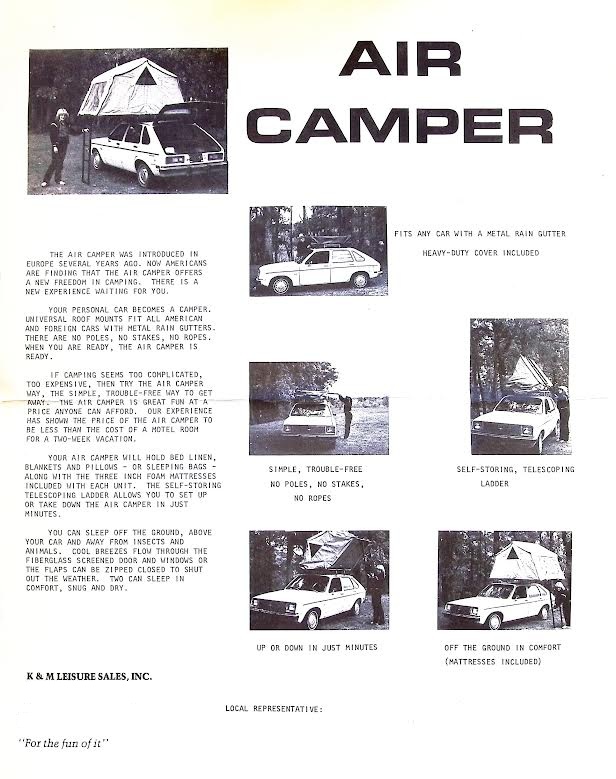
Sometime in the early 1980s, while traveling in Europe, I discovered an interesting camping product. It was a tent that mounted on the roof of an automobile.
At that time, most automobiles still had rain gutters along the edges of their roofs. The tent was designed to attach to those gutters, making it possible to turn an ordinary car into a camper.
The ingenious part was how easily the tent opened. You simply pulled down a ladder, and the tent popped up into position. There was very little work involved in setting it up.
Once opened, it provided sleeping accommodations for two people. You slept across the width of the automobile, with your head toward one side and your feet toward the other. There was plenty of room inside.
I rented one of these tents in Europe, attached it to a rental car, and spent several days traveling along the southern coast of France. I was impressed with the simplicity and convenience of the arrangement.
When I returned to the United States, I began investigating whether I could import the tents and sell them here. To my surprise, I discovered that they were actually being manufactured in Indiana. That made the business opportunity even more attractive. I wouldn't have to deal with importing them from Europe.
Starting Another Business
At Lawrence Tech, I knew a fellow teacher named who had expressed an interest in getting into business. He wanted to make additional money, and because he was a teacher, he had his summers available.
I thought this would be a perfect opportunity for him. We could buy these unusual car-top tents, advertise them, and sell them to people interested in camping and traveling. So he and I formed a company called K & M Leisure Sales, Inc.
I purchased six tents as our initial inventory. We also prepared an advertising brochure, printed on 8½-by-14-inch paper, describing the tents and their advantages. We intended to distribute the brochures and post them in appropriate places to attract customers. I still have a copy of that brochure today.
The idea seemed straightforward. We had an interesting product, an American manufacturer, and a partner who supposedly had both the time and the desire to sell it. Unfortunately, things didn't work out that way.
But let me interject here with a family story.
A Family Camping Trip
Around that same period, probably sometime in the mid-1980s, Jean and I took our two sons, Dave and Mike, on an extended camping trip through the eastern and southeastern United States.
We traveled in a green Plymouth van that I had purchased from a neighbor named Alex and his wife, Joyce. Alex had modified the interior of the van to provide sleeping accommodations for his children. He had two daughters and a son, and the van had been arranged so the children could sleep inside. That made it ideal for our trip.
We mounted one of the car-top tents on the roof. Jean and I slept in the tent on top of the van, while Dave and Mike slept inside.
It was a remarkably convenient arrangement. We could stop at a campground, pull down the ladder, pop up the tent, and be ready for the night without much effort. Or we could boondock with a small portable toilet available.
We traveled for several weeks, camping along the way. One incident from that trip has stayed with me.
We were traveling through Virginia, and the boys were talking in the back of the van. After listening to them for a while, I finally stopped to find out what was going on. It turned out that after approximately three weeks of camping, they wanted to stay in a motel.
They weren't looking for better beds or more comfortable accommodations. They wanted a swimming pool!
I remember that we stopped at a motel called the Patrick Henry. I don't remember the exact city, although I believe the motel was still operating when I checked on it many years later. That swimming pool apparently offered something our car-top tent couldn't provide.
The trip itself was a success, and the tent worked very well. Jean and I had comfortable sleeping accommodations, and the boys had their own space inside the van. It certainly demonstrated to me that the product was practical.
But back to the business story.
Six Tents and No Sales
Eventually, summer ended and the school year began again. I asked my university colleague how many tents he had sold. The answer was none—not a single one.
Despite all his enthusiasm about wanting to get into business and make money, he hadn't sold any of our inventory. I had expected that he would devote his summer to developing the business. Instead, we were right back where we had started, with six tents and no customers.
I eventually managed to sell the six tents we had purchased. I also sold the one Jean and I had used, because I didn't expect that we would need it again. That was the end of K & M Leisure Sales, Inc.
We had a good product, but we didn't have the sales effort necessary to make the business successful. I had made the mistake of assuming that because someone wanted to make money, he would also be motivated to do the work required to earn it. That turned out to be an expensive assumption.
Failure No. 2: Lake Lawns
My second unsuccessful venture was a lawn-treatment company called Lake Lawns. This business developed out of my aquatic weed-control operations in Michigan.
Through Aqua Weed Control, we were already working on lakes and had become acquainted with many of the homeowners living around them. It seemed logical that if we could treat the weeds in their lakes, we might also be able to provide lawn-treatment services that helped reduce the amount of phosphate entering those lakes.
One of the concerns with traditional lawn fertilizers was phosphorus. Phosphorus that washed into lakes could contribute to excessive algae and aquatic plant growth. We decided to offer lawn treatments that didn't contain phosphorus.
Years later, Michigan would adopt statewide restrictions on the application of phosphorus fertilizers to lawns, effective in 2012. We had been offering phosphorus-free treatments long before that.
The IBDU Fertilizer
One of the products we used was called IBDU, which stood for isobutylidene diurea. It was a slow-release nitrogen fertilizer that had been used for many years in the commercial turfgrass industry.
IBDU came in the form of very small white pellets. The nitrogen was released gradually, providing nutrients to the grass over an extended period. The product sounded ideal for our purposes, but it created some practical problems.
We applied our lawn treatments through a hose that could be pulled across the grass. Unfortunately, the hose was relatively narrow, and the little white IBDU pellets had a tendency to accumulate inside it. Eventually, the hose could become plugged with the material.
I remember dealing with that problem, and we eventually switched to a different product. But our success created a different problem.
Growing Faster Than We Could Handle
We had a partner in Lake Lawns, and he was particularly effective at finding customers. Because we were already treating the lakes, we knew many of the homeowners in those neighborhoods. My partner would go from house to house, knocking on doors and offering our lawn service. I didn't do much of the selling myself.
Sometimes my partner would call me and announce that he had signed up another 30 customers that day. The business grew rapidly—in fact, much faster than we were prepared to handle.
We had only one truck, and I was still occupied with teaching at Lawrence Tech and operating my other business interests. We were making money, but we didn't have the management and quality-control systems necessary to keep up with the growth.
Our Truck and Trailer
Our lawn-treatment equipment consisted of a truck with the chemicals and a relatively small water tank in the back. We also pulled a trailer carrying a much larger water tank. The trailer provided the additional water capacity we needed to service lawns along our routes.
One of our employees had an interesting experience with that equipment. He was driving along Telegraph Road in the Bloomfield Hills area, somewhere around Square Lake or Lone Pine Road. He made a right-hand turn onto Woodward Avenue.
It had been raining, and the pavement was somewhat wet. As he made the turn, the trailer carrying the large water tank went up onto the median. We had to go out and retrieve it.
That was another example of the practical problems involved in operating a business with equipment and employees when I wasn't directly supervising everything.
The Lawns That Weren't Sprayed
The most serious problem, however, involved another employee. My wife, Jean, handled the billing for Lake Lawns. One day she sent out bills for lawn treatments that were supposed to have been completed. Then the telephone calls began.
Customers were calling to say that nobody had treated their lawns. One customer explained that they had been holding a yard sale on the day the lawn was supposedly sprayed. Another had friends visiting. Other customers had similar explanations. They knew that nobody could have been on their property applying chemicals at the time we claimed the work had been done. Naturally, they wanted to know why they were being billed.
My partner and I decided that we had better find out what was happening. So one day we followed our lawn-treatment truck.
What we discovered explained the complaints. The employee would work during the morning, but around one or two o'clock in the afternoon, he would stop at a bar rather than continue his assigned route.
We concluded that he had a drinking problem, although what we could establish firsthand was that he was not completing his work.
I never did find out exactly what happened to the unused chemicals. Perhaps he started the following day with a partially filled tank and simply added more material. I don't know.
The fact is that we weren't checking closely enough to make sure the work was actually being performed. We had a billing system, but we didn't have an adequate system for verifying that our customers were receiving the service they were paying for.
Hiring Someone I Knew
There was another interesting aspect to the employee problem. I had previously worked with this employee and hired him when he approached me looking for a job, I hired him.
After discovering what was happening with our lawn-treatment routes, we fired him. We subsequently learned that he had also been fired from his previous position at where I had had worked with him. It was another lesson about hiring people and assuming that they would perform their responsibilities without close supervision.Selling Lake Lawns
Eventually, I decided that I had had enough. Lake Lawns had customers, was growing, and was making money. But it was also creating problems that I simply didn't have the time or inclination to manage properly.
I was teaching, operating Aqua Weed Control, and involved in other activities. Lake Lawns needed someone who could give it direct attention.
I sold the business, including the truck and equipment, to one of my students at Lawrence Tech. As I remember it, the selling price was approximately $5,000. That ended my involvement in Lake Lawns.
Remembering Lake Lawns 40 Years Later
An interesting thing happened as I was writing these stories: this entire episode came back to me.
During the night of October 19–20, 2026, I was restless after about 5 a.m., thinking of my river trip in Europe later that week. Suddenly, the name Lake Lawns came into my mind. Then I remembered the fertilizer we had used: IBDU.
I hadn't thought about either name in many years. Rather than risk forgetting them again, I sent myself a couple of short emails containing just those names. Those two little reminders brought back the entire experience and eventually led to writing this story.
What I Learned from My Business Failures
Looking back, I find it interesting that both of these unsuccessful businesses involved partners. With K & M Leisure Sales, I expected my partner to do the selling, but he didn't. With Lake Lawns, my partner was very successful at selling, but we didn't have adequate management and supervision to handle the business we generated.
In both cases, I had other things occupying my time and wasn't providing the attention that a small business needs.
The contrast with Aqua Weed Control is interesting. That business became very successful, and I operated it without any outside partners. Jean was involved, and together we were able to make it work.
I don't think the lesson is necessarily that p artnerships are bad. Rather, a business needs somebody who is clearly responsible for making sure things get done.
A good idea isn't enough. Having customers isn't enough. And having employees doesn't mean that the work is necessarily being done. Those were lessons I learned through experience, sometimes rather expensively.
I suppose that is one of the reasons these two businesses deserve a place in my collection of stories. They were failures, but they were also part of my education in business—an education that continued long after I began teaching the subject to other people.