Big Fire on Queens Boulevard
I had a lot of energy as a youngster, and a lot of curiosity. Let's just start out with that. I had a lot of energy.
Our Early Days in Woodside, Queens
The time frame was likely within the first two to four months of our arrival in New York City, probably in the early 1940s. We were living in Woodside, Queens, and I remember our shopping trips.
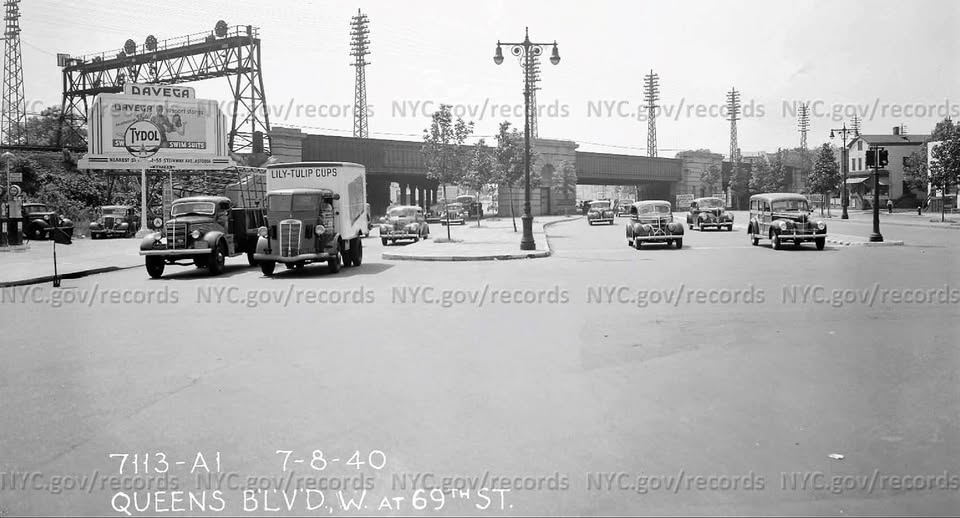
On one trip, we went down to Queens Boulevard, our usual destination. You can find Queens Boulevard on a map today. It's still a major street, but it doesn't look the same as it looked then.
I was down there with my mother, and she was talking to some other ladies. I think they had agreed to go shopping together for groceries, and the baby carriages were used to take the groceries home.
That was a practical arrangement in those days. You could walk to the stores, buy your groceries, load them into the baby carriage, and walk back home. The women could visit with one another while they shopped, and the children, like me, were along for the trip.
The Mysterious Pole on Queens Boulevard
There was a pole there, and I didn't understand what the pole was for. My mother never explained, "This is this kind of pole," or told me to be aware of it, or to leave it alone, or anything like that.
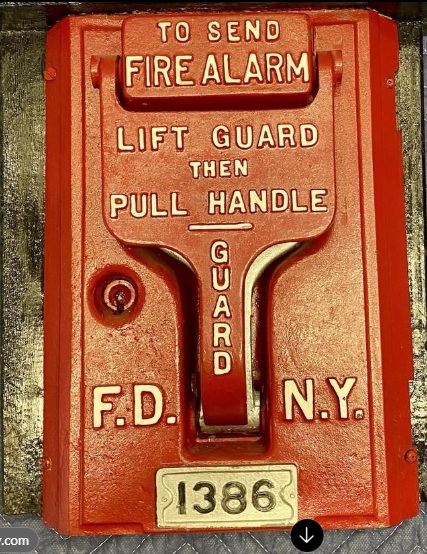
What was mounted on that pole was a New York City fire alarm box.
These fire alarm boxes were common on street corners throughout New York City in those days. Many were made of heavy cast iron, painted red, and attached to metal poles. Some had rather decorative designs, while others were more utilitarian. They had a handle or lever that a person could operate to summon the fire department.
This was long before people carried telephones in their pockets. In fact, many families didn't even have telephones in their homes. If someone discovered a fire, one of the quickest ways to summon help was to run to the nearest fire alarm box and pull the handle.
The boxes were designed to be operated by ordinary citizens. Depending on the model, a person might have to lift a protective guard before pulling the handle. The handle had some mechanical resistance, but it wasn't intended to require great strength.
Little Ernie Pulls the Fire Alarm
And what little Ernie did was reach up and somehow—I don't know whether I climbed up on a garbage can. I have no idea how I got there, but I grabbed—yes, I grabbed the fire alarm, and I yanked it.
All hell broke loose.
How New York City's Fire Alarm System Worked
What I didn't know was that pulling that handle started a rather remarkable system of mechanical and electrical communication.
Inside the fire alarm box was a spring-driven mechanism, somewhat like the workings of an old-fashioned clock. Pulling the handle released that mechanism, which turned a specially designed wheel. The wheel had notches or teeth arranged in a pattern that represented the identifying number of that particular fire alarm box.
As the wheel turned, it repeatedly opened and closed an electrical circuit, sending a series of signals through wires connected to the fire department's central alarm office.
The clever part was that the box didn't need its own electrical power supply. It didn't need a battery inside the box, and it didn't depend on electricity from the nearest building. The mechanical movement came from the spring-driven clockwork, while the electricity for the signaling circuit was supplied by the fire alarm system itself, generally from batteries maintained at the central office.
Each box had its own number, and the pattern of electrical interruptions transmitted that number automatically. The signal was repeated several times so the receiving operator could identify it accurately.
At the central alarm office, the signal could be received on bells, telegraph sounders, or recording equipment that marked the coded number on a strip of paper. The operator could then identify the street corner from which the alarm had originated.
The operator didn't have to ask anyone where the fire was. The number told the fire department where the alarm had been pulled.
The alarm office then notified the appropriate firehouses, where the firefighters could respond with their engines and other equipment.
All of that happened because one little boy had pulled a handle on Queens Boulevard.
The Fire Trucks Arrive
And there were more fire trucks than I probably could have counted at that age. In my young mind, Queens Boulevard must have been a five-alarm fire area, because it seemed as though an entire fleet of fire trucks had arrived.
Actually, a single pull of the box would normally have brought an initial response, not automatically a five-alarm response. But to a little boy watching fire engines come roaring into the neighborhood, it certainly seemed like a five-alarm fire.
The neighborhood quickly changed in the next minute or three, and everybody came over.
One moment, my mother and the other ladies were standing there with their baby carriages, talking and shopping. The next moment, fire trucks were arriving, firemen were getting out, and people were gathering to see what was happening.
Of course, there was no fire.
My Mother's Reaction and the Firemen's Explanation
My mother looked at me, and I must have had my ears turn red or whatever. I don't know if she even knew the fire alarm was there until the firemen came and knew that was the box, because they were all numbered and coded.
Needless to say, they weren't harsh with me, but they explained to me what it was. And everybody—I don't think they got a good laugh out of it.
There was a serious reason for that. A false alarm brought firefighters and equipment away from their stations when they might have been needed somewhere else.
New York City During World War II
And this was during World War II.
New York City was living with wartime precautions and uncertainty. People were familiar with blackouts, air raid warnings, neighborhood patrols, and the possibility of danger. The sudden arrival of fire trucks and the gathering of a crowd would have been a much more serious interruption than an ordinary neighborhood commotion.
With all the tensions of World War II and everything else, especially being in New York, when I set that alarm off, everything changed. Put it that way.
A Lesson I Never Forgot
I don't remember being punished, and I don't remember the firemen being particularly angry with me. What I do remember is that they explained what the fire alarm was for, and I learned something that day about the consequences of pulling a handle without knowing what it did.
That's the way it happened.
And I remember the baby carriage and the effects of pulling the alarm. I don't really even remember pulling the alarm, but I sure remember the effects.
Remembering Queens Boulevard More Than Eighty Years Later
It's remarkable what stays in your memory after more than eighty years. I can't tell you exactly how I reached that handle. I can't tell you how many fire trucks arrived. And I can't tell you exactly what my mother said to me afterward.
But I can still remember that ordinary shopping trip on Queens Boulevard, my mother talking with the other ladies, the baby carriage, and the sudden excitement when the fire department arrived.
There was no fire on Queens Boulevard that day.
But for a few minutes, thanks to little Ernie, it certainly looked as though there was a big one.
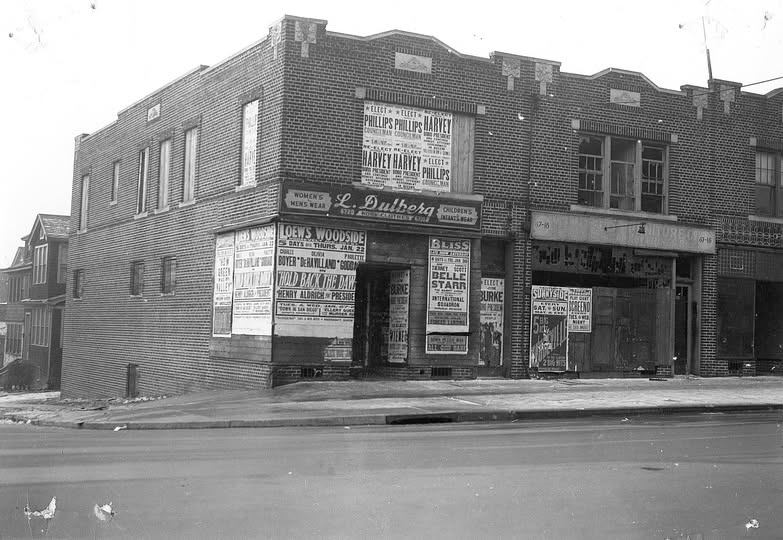
Historic Woodside Avenue in Queens, 1941
Two-story brick buildings. Closed clothing store covered with movie and election posters. 67-18 and 67-20 Woodside Avenue, Queens. Now the site of a BQE overpass
Queens Boulevard and 69th Street, Woodside, Queens, July 8, 1940
About Woodside, Queens from Wikipedia
A community profile, published in 1943, characterized Woodside (along with Winfield, its neighbor to the south) as "a district of small homes and middle incomes." The area still had few apartment buildings and very little industry. Although the rapid population growth of the 1920s had fallen off in the 1930s, the authors of the profile expected improved transit (the IND Queens Boulevard Line which opened in 1933) and a new shopping center to draw larger numbers of new residents. The number of single-family houses is given as 2,159, double-family houses as 1,711, and larger residential buildings as 868.