Blackened Potatoes
This is a very positive memory from my childhood. My dad, Stanley Maier, was plant manager for the Gordon Baking Co., the bakers of Silvercup Bread, a major bread brand in New York at the time. Stan was 40 years old in 1944 and in the middle years of his career.
Silvercup Bread During World War II
During World War II, New York City was served by several major packaged-bread brands, including Silvercup, Wonder, Bond, Tip-Top, Dugan's, and Fink's.
Silvercup was particularly important in the New York metropolitan area. Its enormous Long Island City bakery was one of the largest bread-producing plants in the country. Historical accounts indicate that, at its peak, Silvercup supplied roughly one-third of the bread consumed in the New York metropolitan area. Wonder, Bond, and Tip-Top were among its major competitors.
Bread was an everyday staple and inexpensive by today's standards. During the wartime period, a standard loaf commonly sold for roughly 10 to 13 cents, depending on the brand and size.
Dad's Victory Garden
I included that background because, even though Dad held such a responsible job, he also grew a substantial Victory Garden.
Our area of Woodside, on Long Island, was what we might describe today as the outer edge of suburbia. Working in his garden was a common after-work and weekend activity for Stan.
Potatoes in the Coals
A favorite evening ritual was a campfire. I don't remember anything like s'mores. Instead, we would put potatoes directly into the coals. As I recall, we didn't even wrap them in anything.
These must have been big russet potatoes—the biggest potatoes you could get. They would go into the coals when the fire was almost out. Later, when the fire had died down even more, my dad would pull them out.
We would eat these blackened “baked” potatoes, and I thought they were delicious. We probably put just a little salt and pepper on them, plus the ever-available oleo.
I don't know how long he left them in or exactly how far the coals had burned down, but he wasn't cooking them in an active fire. Somehow, he cooked them with the heat remaining in the coals. I think Dad poked them to determine when they were ready.
The Garden Site Today
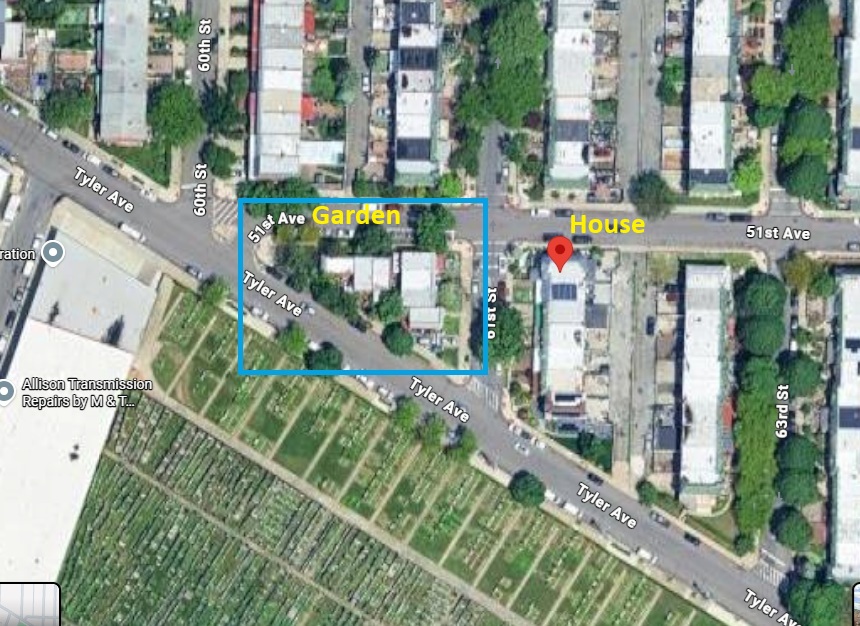
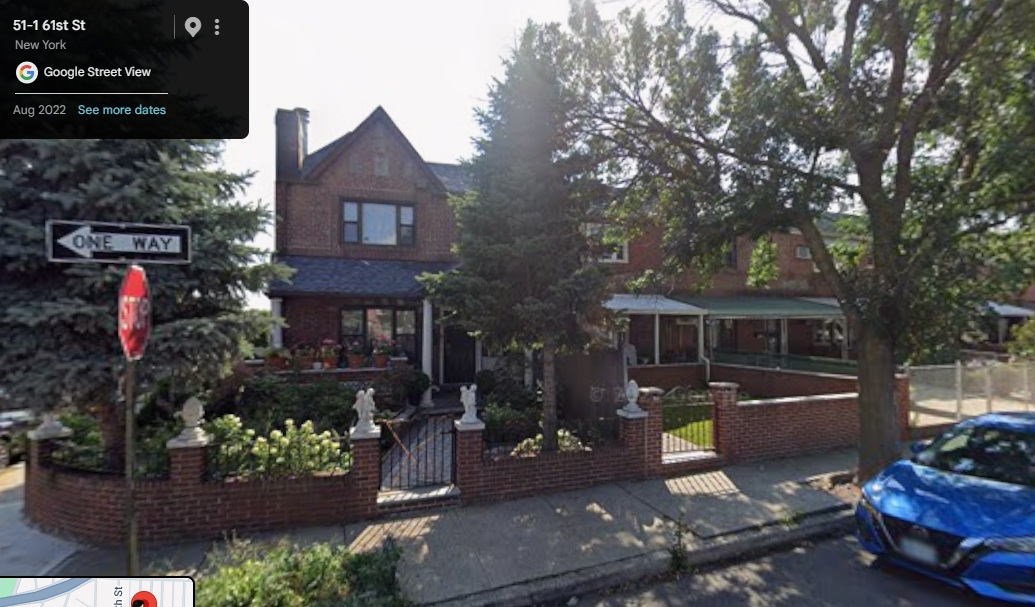
The footprint of the Victory Garden can be seen on Google Earth as the triangular piece of land, now occupied by buildings, across from our front yard at 51-01 61st Street, Woodside, Long Island.
For laughs, check Zillow for the house's value today. $1,012,605. The historical price information is lost, but I estimate that the house might have been worth $2,000 back then—at most.
In addition to growing food, and the bonfires in the Victory Garden land, someone arranged to have somebody come in, (or maybe it was just somebody that was doing it on their own), and figured out they could make some money. They would bring ponies there so kids like me could ride them for a few pennies or nickel. I don't remember whether the cost was for a certain amount of time or a certain number of rides around the perimeter of the triangle of land.
I recall someone walking along side of us, which makes sense from a safety point of view. I think I remember that because I wanted to ride faster than the person who was walking.
Interestingly, years later Jean and I took Karen and Mike to Belle Isle to ride the ponies there. I have pictures of our Best Man, Johnny McDonald, and his wife Linda with us with their sons Johnny and Gary. The riding experience in 1970 on Belle Isle was distinctly different. There the ponies were attached to a mechanism that rotated as the ponies walked. This is known as a "pony sweep" or circular pony ride.
The ponies were individually saddled and attached by leads or arms to a central rotating mechanism. As the ponies walked, they followed a fixed circular path. This allowed several children to ride without an attendant having to lead each pony. Sadly, the efficiency of the arrangement makes sense.
An attendant was still there to help children mount and dismount, supervise the ride, and care for the ponies, but not necessarily to walk alongside every animal. Another loss for freedom in exchange for efficiency.
Where Victory Garden Was