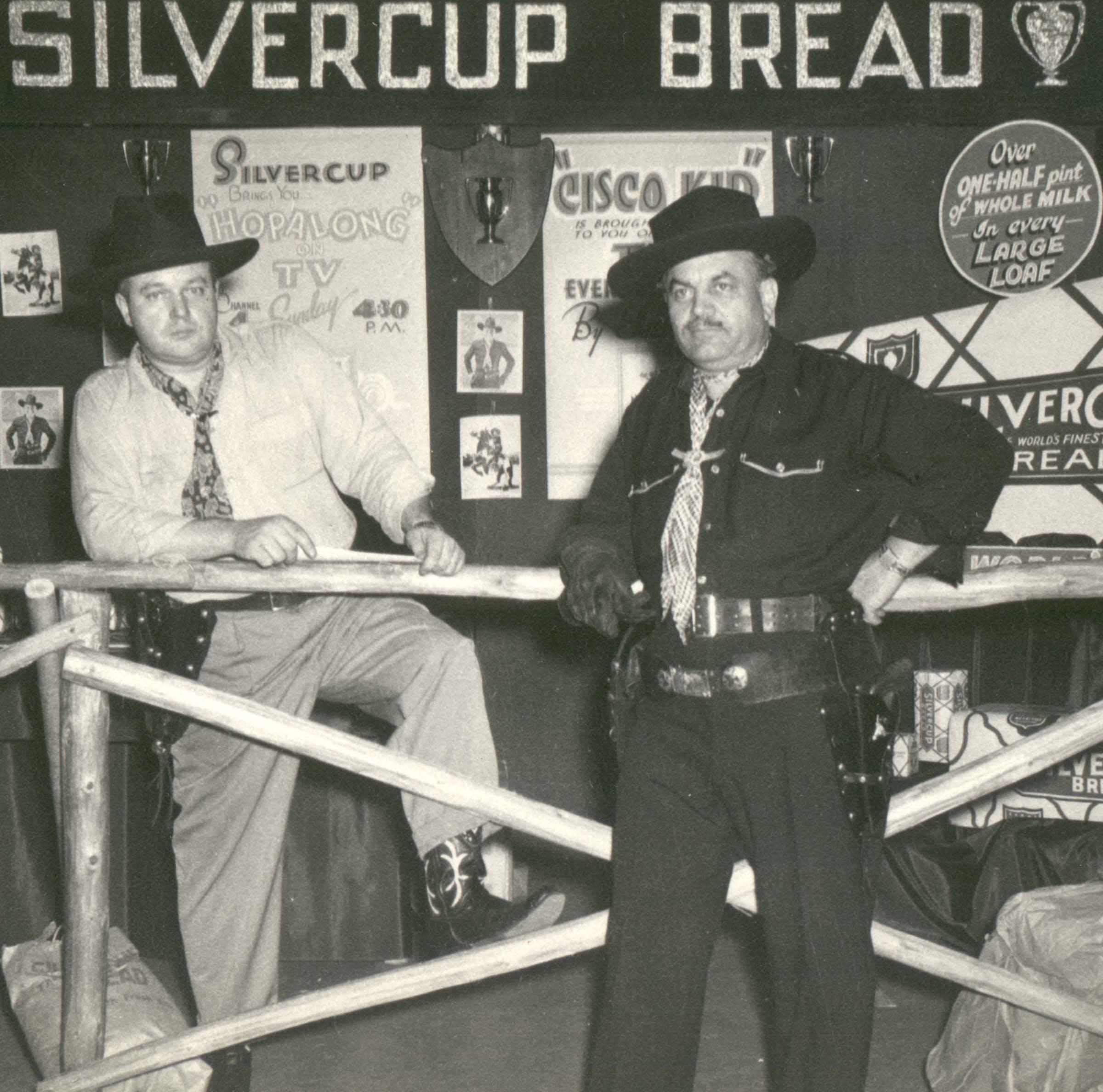
About Silvercup Bread Photo Below
The photograph captures a significant moment in the public relations history of Silvercup Bread, featuring key individuals who drove the brand's presence in the midwestern market.
Stanley George Maier (The Man in Black): The man pictured in the distinctive black outfit is your father, Stanley George Maier. He wore this specific attire as a deliberate marketing tie-in with iconic Western characters of the era—including The Cisco Kid, Hopalong Cassidy, and The Lone Ranger.
Gene A. Nuziard: Standing next to your father is more than likely Gene A. Nuziard, who began his journey as a baker before climbing the ranks to become the President of Silvercup Bakeries. He eventually executed a strategic business maneuver to essentially buy out the operation, separating its identity from the original Gordon Baking Company.
The Promotional Context: Your father wore his signature black outfit when representing the company at public events, county fairs, and community gatherings. Because Silvercup aggressively sponsored these legendary television and radio Western heroes, dressing in character was a primary way to engage with the public and drive brand loyalty. This strong, ongoing association with Western entertainment explains why the backdrop features visual elements like a rustic farm fence post.
The visual marketing materials from this era perfectly illustrate the unique philosophy—and the eventual financial vulnerabilities—of the company.
The Half-Pint Emblem: The prominent circle in the upper right-hand corner of the advertisement proudly declares: "our 1/2 pint of whole milk in every large loaf."
European Freshness vs. Preservatives: This emblem represented the Gordon Baking Company's unyielding commitment to premium, rich, European-style scratch baking. They refused to use dry milk powders or cheap chemical binders. Instead, they relied on liquid whole milk and a daily fresh-delivery model. Drivers operated like milkmen, delivering fresh bread to neighborhood grocers daily and aggressively pulling back the previous day's unsold "stale" bread.
The Chain Store Shift: This refusal to compromise ultimately led to severe financial difficulties when dominant grocery chains like Kroger and the regional A&P on Mack Avenue near Maxwell revolutionized the grocery sector. These supermarkets demanded a 4-to-5-day shelf life. While major competitors loaded their bread with artificial preservatives to secure shelf space, the leaders of the Gordon Baking Company proudly refused to alter their wholesome recipe, causing them to fall behind the modern, high-volume retail supply chain.
Summary of the Historical Elements
Stanley George Maier Your father, pictured in a black outfit styled after Western heroes to represent Silvercup Bread at fairs and public events.
Gene A. Nuziard Pictured next to Stanley; the ambitious baker who rose to become President of Silvercup and bought out the operations.
The "1/2 Pint of Milk" Circle The advertising emblem proving their premium recipe, which ultimately made their bread too expensive and short-lived to compete with preservative-heavy supermarket bread.
The Farm Fence Post Backdrop
Visual theme representing the company's heavy
sponsorship of Western characters like
The Lone Ranger, Hopalong Cassidy,
and The Cisco Kid.
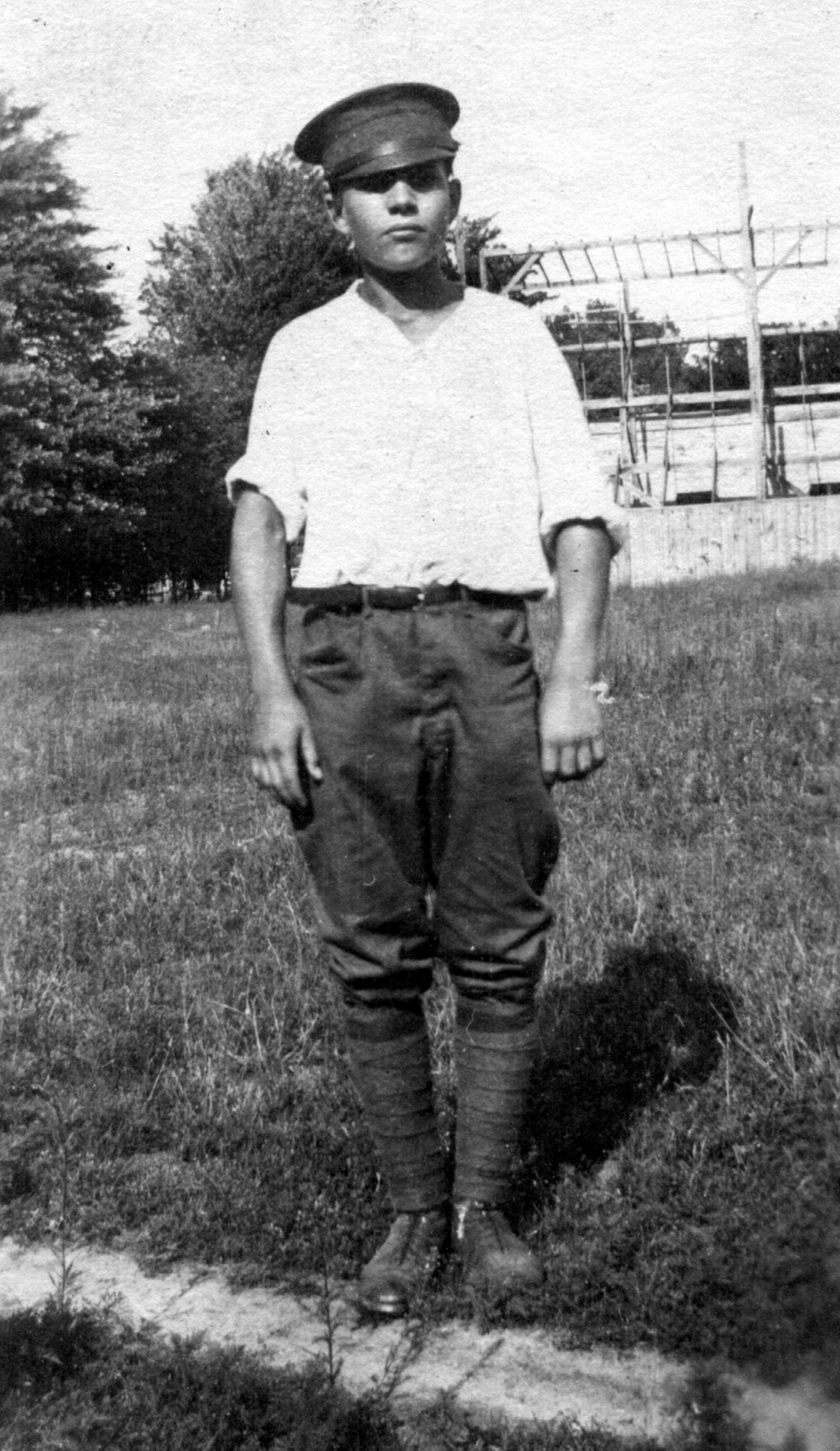
Stanley Maier, Circa 1917–1918
This photograph shows Stanley George Maier, born August 21, 1904, at approximately 13 or 14 years old. He wears what appears to be a World War I-era U.S. Army enlisted man’s service cap with its military insignia removed. It may have been given or loaned to him by someone who served in the Army, although its origin is unknown.
The photograph was taken outdoors, possibly in the Detroit area, with what looks like a barn under construction in the background. Although the exact location and circumstances are unknown, the image offers a glimpse of Stan as a young teenager during the closing years of World War I.
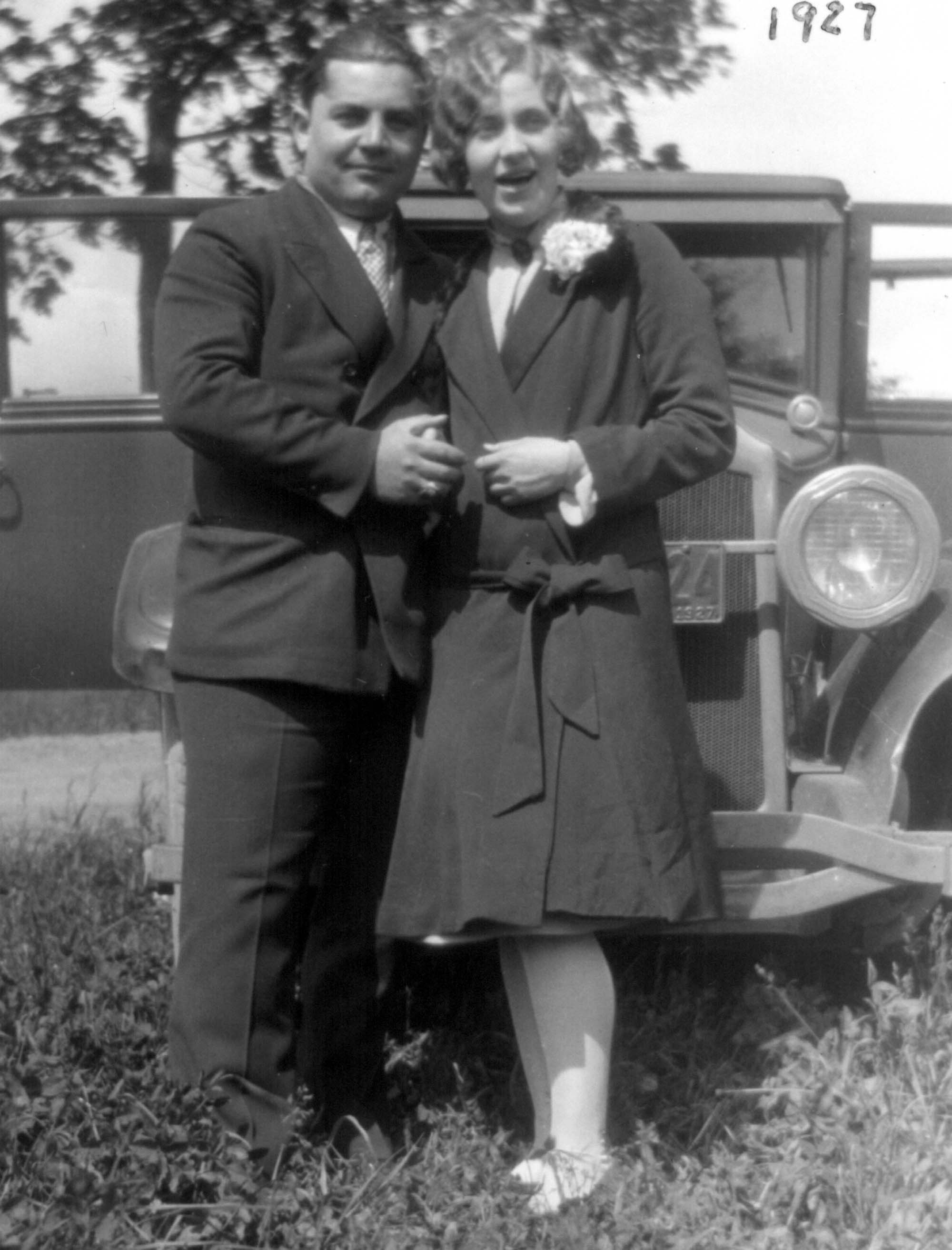
Stanley and Mildred Maier — 1927
A Photograph from Their Courtship Years
This photograph, dated 1927, shows Stanley George Maier, born in 1904, and Mildred Elizabeth St. Aubin, born in 1907. At the time, Stanley would have been approximately 23 years old and Mildred about 20.
The photograph was taken during their courtship. Mildred is wearing a flower on her coat, and both are dressed rather nicely for what appears to be an outdoor photograph taken in a grassy, undeveloped area, probably somewhere around Detroit.
Behind them is an automobile that appears to be a 1925–1927 Dodge Brothers sedan, possibly a 1926 model. The distinctive radiator, large headlights, small cowl lights, and upright body are characteristic of automobiles of that period.
The automobile is interesting for another reason. Mildred's father, Louis A. St. Aubin, was involved in the lumber business in Detroit and, according to family history, supplied wood to automobile manufacturers during the years when wooden components were still widely used in automobile construction.
Dodge Brothers was among the early manufacturers to introduce all-steel automobile bodies, but even these automobiles retained wooden components in their floors and interiors. The automobile industry continued to be an important consumer of lumber during that period.
Family history indicates that Mildred's family was financially comfortable during her younger years. She attended a private girls' school in Indiana, and she had an automobile while still a young woman. The car in this photograph might actually have belonged to her.
The photograph also provides a glimpse of Stanley and Mildred as young people, before their marriage and before the birth of their children. Mildred's distinctive hairstyle and the flower on her coat, together with Stanley's formal suit, make this a particularly appealing picture of the two of them.
A Family Day at Rockaway Beach — September 14, 1944
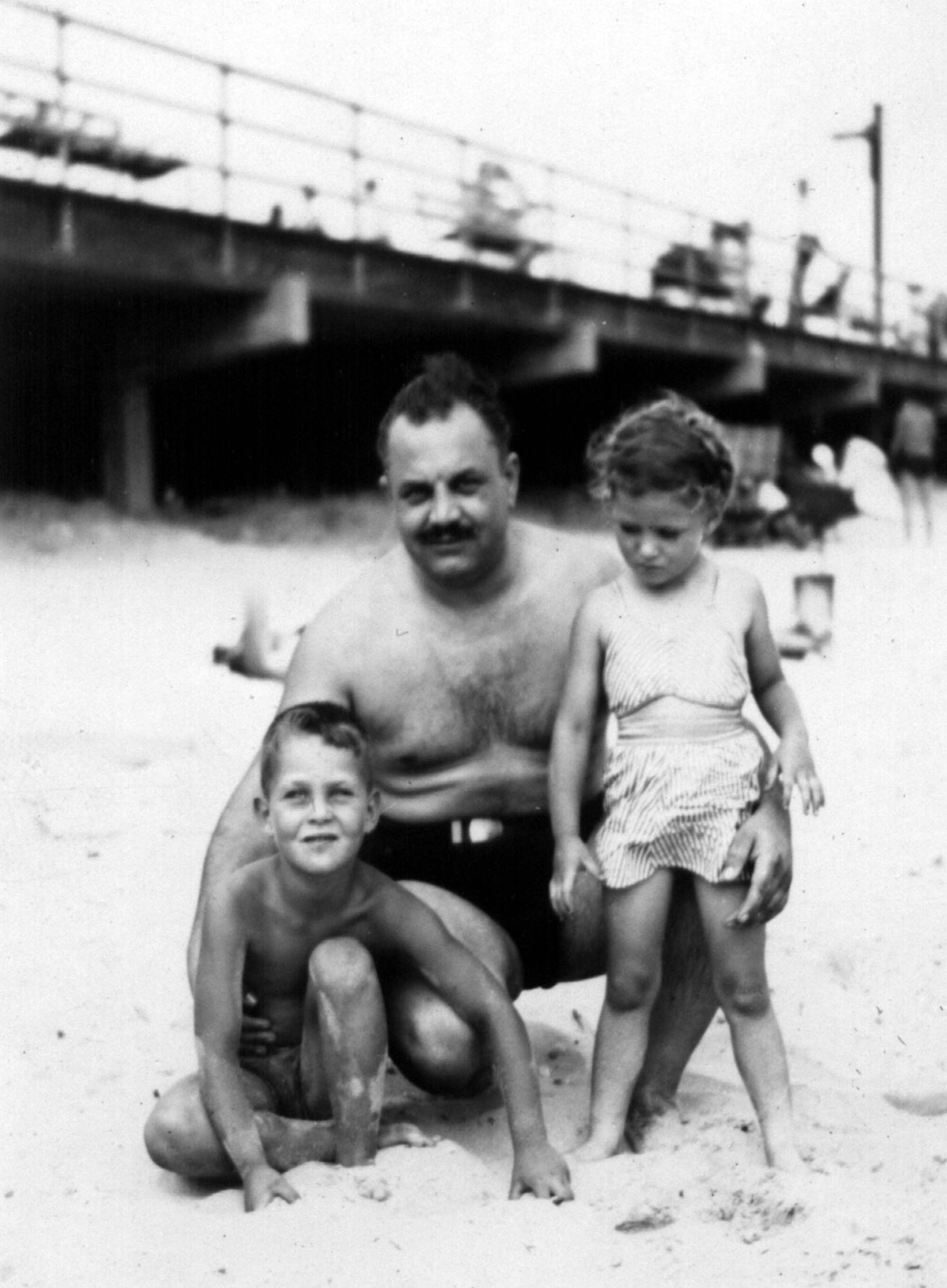
This family photograph shows Stanley Maier and his two young children at Rockaway Beach on Long Island, New York, on Thursday, September 14, 1944. During World War II, Stanley, his wife Mildred, and their children lived at 51-01 61st Street in Woodside, Queens.
Stanley crouches on the sand with his six-year-old son, Ernest, in front of him. His three-year-old daughter, Cathie, stands beside him near his left shoulder. Mildred took the photograph. All three are barefoot, with what appear to be benches and part of a pier or boardwalk in the background.
At age 40, Stanley was deeply tanned, reflecting his lifelong enjoyment of sunshine. His dark hair was beginning to thin, and he wore a bathing suit with a distinctive metal buckle at the waist—a suit he continued to keep for years afterward. The photograph captures a happy moment shared by a father and his children while the war continued overseas.
A Memorable Ride Home During the Great Atlantic Hurricane
As the family enjoyed their outing, the Great Atlantic Hurricane of 1944 was moving north toward Long Island, bringing powerful winds, heavy rain, dangerous surf, and flooding to the New York area. Hurricane conditions developed that evening, and the storm’s center crossed eastern Long Island at approximately 10 p.m.
On the return trip, the family’s automobile encountered flooded streets. Water rose above the running boards and entered the passenger compartment. Ernest, still barefoot in the back seat, remembered water covering the floor and reaching his toes. The children’s bare feet in the photograph connect the beach outing with that vivid childhood memory.
The photograph preserves a cheerful family scene shortly before severe weather transformed an ordinary trip to the beach into an experience that remained part of Maier family history.
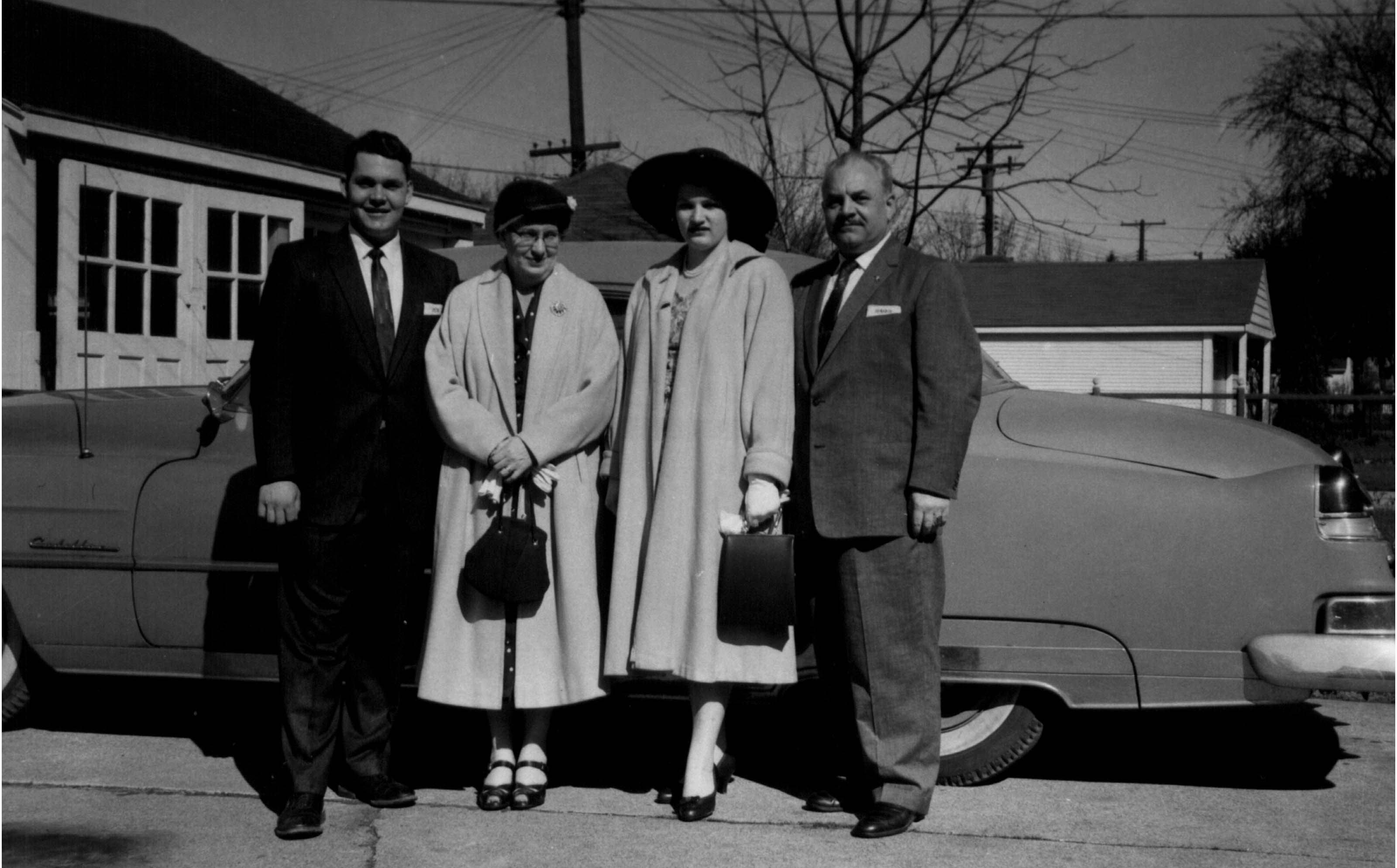
Family Photograph at 4643 Balfour — Easter 1959 or 1960
This photograph shows four members of the Maier family in the backyard of our home at 4643 Balfour in Detroit. From left to right, as you look at the picture, are me, my Aunt Eva, my sister Cathie, and my father. I believe it was taken at Easter in either 1959 or 1960. Looking at the details and remembering the circumstances, Easter of 1960 seems the most likely.
Besides the people, one of the most interesting things in the photograph is the car behind us: a 1949 Lincoln. It was the only car our family had at the time, and my father let me drive it. How we came to own that Lincoln is a story of its own.
The Accident and the 1949 Lincoln
When I was about sixteen or seventeen, I was driving my parents and my sister on a Sunday outing. Sunday drives were common in our family. My father had recently bought a brand-new 1956 Buick, and that was the car I was driving. He sat beside me, my mother sat behind me, and Cathie sat behind him.
We were traveling east on West Long Lake Road, approaching Crooks Road. On the right was a cemetery that I now know was White Chapel Memorial Park Cemetery. I was an inexperienced driver, and when I pulled into the intersection to cross Crooks Road, a car coming from the north at what I remember as a very high speed broadsided us.
The accident put my mother and me in the hospital. My face went through the driver's side window, leaving a scar across my forehead that has faded over the years. My left ear was also partly torn away, but the doctors were able to sew it back into place.
My mother suffered an injury that affected her walking for the rest of her life. Afterward, there was always a slight difference in her step. She never had her hip replaced; that procedure was not common in those days. As I recall, my father and sister were not injured. The Buick had no seat belts.
Immediately afterward, we had no car. My father had many friends, and one of his German friends gave our family the 1949 Lincoln. We did not buy it—it was a gift.
One detail I remember clearly is the location of its gasoline filler. It was concealed behind the taillight visible in the photograph. To put gasoline into the car, I had to lift the taillight assembly to reach the gas cap.
College Dates and Fraternity Parties
I also remember driving the Lincoln on a date with a girl who lived in Birmingham. We went to a fraternity party held at a bowling alley on the west side of Northwestern Highway, just south of Fourteen Mile Road.
The bowling alley was later identified in research accompanying these recollections as Langan's Norwest Lanes & Pizza, also known as Norwest Lanes, at 32905 Northwestern Highway in Farmington Hills. I thought the building was still there and might still be operating as a bowling alley, although that was my recollection rather than something I had confirmed.
The owner's son, Bob Langan, was within a year or two of me in our fraternity, AK Psi, at the University of Detroit. He let us hold parties in a room above the bowling alley and supplied beer without checking identification.
These memories place my use of the Lincoln during my college years and help explain why I date the family photograph to approximately 1959 or 1960. With everyone dressed for a family gathering, Easter of 1960 makes the most sense to me.
Remembering Aunt Eva
Cathie, who was born in February 1941, is wearing the long coat in the photograph. Beside her is my Aunt Eva, a wonderful woman whose story I have not told very often.
Eva never married. She lived with my mother's parents at their house on Stratman and took care of them. I do not remember her having a job outside the home. If she did, it was never discussed with me. She cooked all their meals, and I sometimes went over to cut the lawn and help with other small chores. I no longer remember the street address.
One of my earliest memories of Eva is of her showing me how to use their old telephone. It was a candlestick-style telephone, with a separate receiver on a cord that you held to your ear while speaking into the mouthpiece on the upright stand. Their telephone service was a party line.
I never knew or heard of Eva dating anyone. She always seemed happy and content, with a smile on her face. She was very thin, but I did not think of her as frail or unwell. Above all, she was kind—one of the really nice aunts I was fortunate to have.
My other aunts included my mother's older half sister, Marie, who was married to Al Werthmann; my father's sister, Beulah, who was married to my Uncle Al Lesperance; and my Aunt Eleanor, who was married to my father's brother, Uncle Otto.
If this photograph was taken at an Easter gathering at our house, that would explain why Eva was there. It preserves a welcome glimpse of someone whose quiet care for the family meant a great deal.
The Neighbors and My First Bank Job
The garage in the background belonged to our next-door neighbors, not to us. The two houses had side driveways, with no fence separating the properties.
The neighbors' last name was Bond. They had two daughters, and one was named Iona. I cannot remember the other daughter's name, but I recall an association with World War II and the phrase “I own a bond,” which helped make Iona Bond's name memorable.
Iona later became the personnel manager, or human resources person, who hired me to work in the mailroom of the Detroit branch of the Federal Reserve Bank of Chicago. That connection gives the neighboring house another place in my memories.
The bank building was at 160 West Fort Street in downtown Detroit. In later years, I understood that it housed the editorial staffs of The Detroit News and the Detroit Free Press.
Research notes accompanying these recollections indicated that both newspapers moved into the former bank building in October 2014 and moved out in December 2024. Those notes listed the Free Press's subsequent offices at 19 Clifford Street, near Grand Circus Park, and The Detroit News's offices at 6001 Cass Avenue, Suite 201, in a former Cadillac showroom near New Center.
The Memories Behind the Photograph
What first appears to be a simple family photograph brings together many parts of our lives: an Easter gathering at Balfour, my sister and father, Aunt Eva's kindness, the Lincoln that a friend generously gave us after a serious accident, my college years, and a neighbor who helped me get a job.
I cannot be certain of the photograph's exact date, but I believe it shows our family together in the spring of 1960. The people, the car, and even the neighbor's garage each carry a story that makes the picture more meaningful to me.
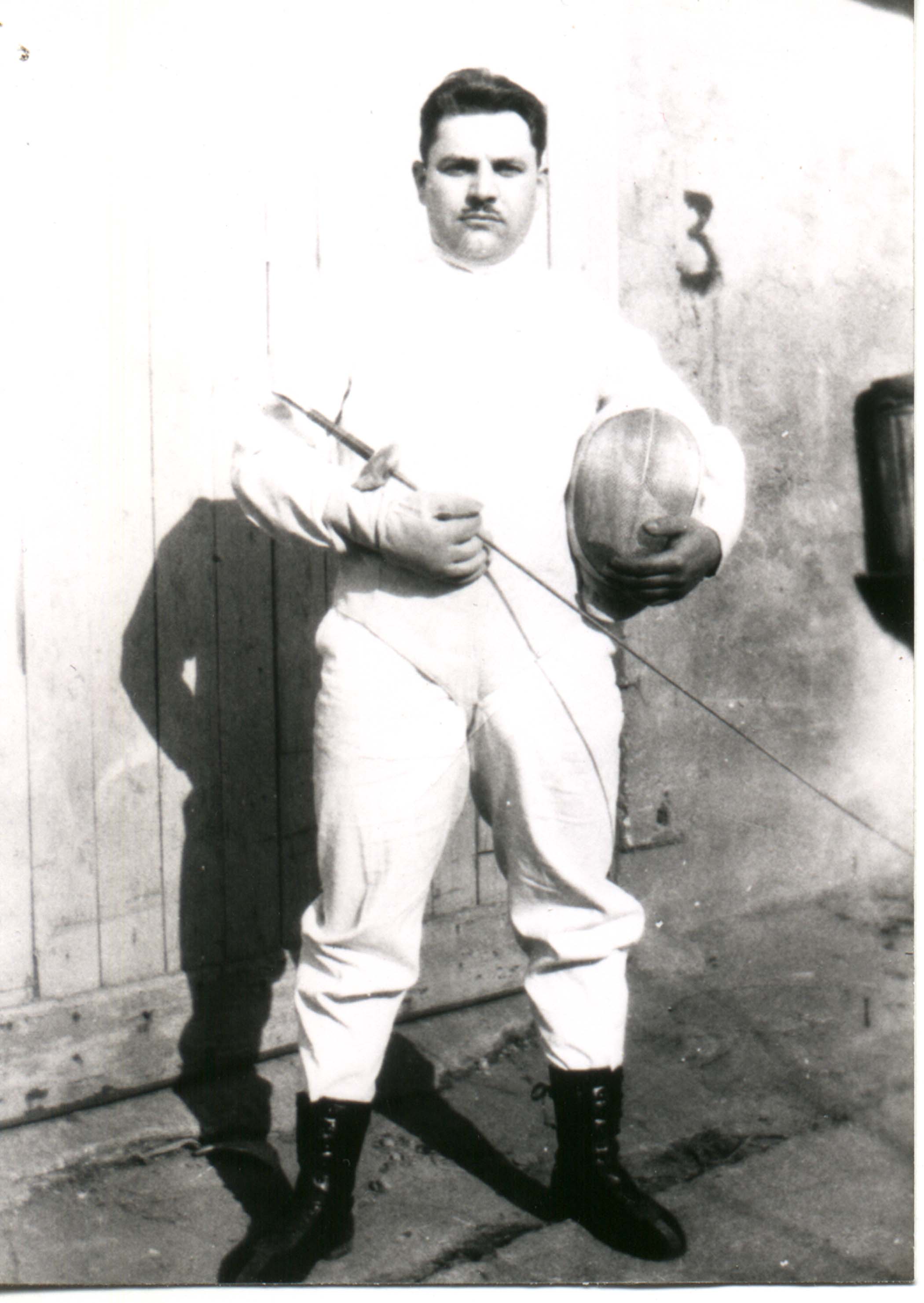
Stanley Maier in His Fencing Clothes
A family photograph shows Stanley Maier as a young man dressed in his fencing clothes. For his son, Ernest “Ernie” Maier, the photograph recalls both his father's interest in fencing and the family's connection to Detroit Turners, an athletic and social club on East Jefferson Avenue in Detroit.
Ernie estimated that Stanley was approximately 25 to 32 years old when the photograph was taken. He thought it might date from before Stanley's marriage to Mildred, although he could not be certain. The photograph's exact date remains unknown.
Ernie remembered Stanley's fencing equipment as including special shoes, a protective outfit, and gloves. He described padding extending from the groin to above the shoulders. In the photograph, Stanley holds a fencing mask with a heavy wire-mesh screen intended to protect his face.
Ernie also recalled fencing weapons with hand guards and remembered that one was called a foil. His recollections suggest that Stanley practiced fencing as a young man, although they do not establish the particular weapon shown in the photograph or whether Stanley competed formally.
A Family Connection to Detroit Turners
A number three appears in the background - perhaps a garage door. Thus, the photograph may have been taken somewhere other than Detroit Turners.
Stanley was a member of Detroit Turners. The club belonged to the German-American Turner tradition, which combined physical fitness and athletic activities with social and community life. Stanley's interest in fencing fits naturally within that setting, although the family's recollections do not establish where he learned or practiced the sport.
During the years the Maier family lived at 4198 Seminole Street on Detroit's east side, the clubhouse was only a short drive away. The family attended parties and other gatherings there, making Detroit Turners part of their recreational and social life.
Ernie particularly remembered the club's indoor swimming pool, where he and his sister, Cathie, swam laps. He was unsure whether they participated in a formal swim team or a program organized within the club, but the swimming remained a clear childhood memory.
He also recalled attending an event at which G. Mennen “Soapy” Williams appeared. Ernie could not remember whether Williams was campaigning for governor or already serving in office, leaving the occasion undated.
Stanley's fencing photograph preserves a glimpse of his life as a young man, along with memories of a club that later provided recreation and companionship for his family. Stanley certainly had many athletic interests with the swimming, celebrations, and family outings becoming part of the Maiers' life in Detroit.
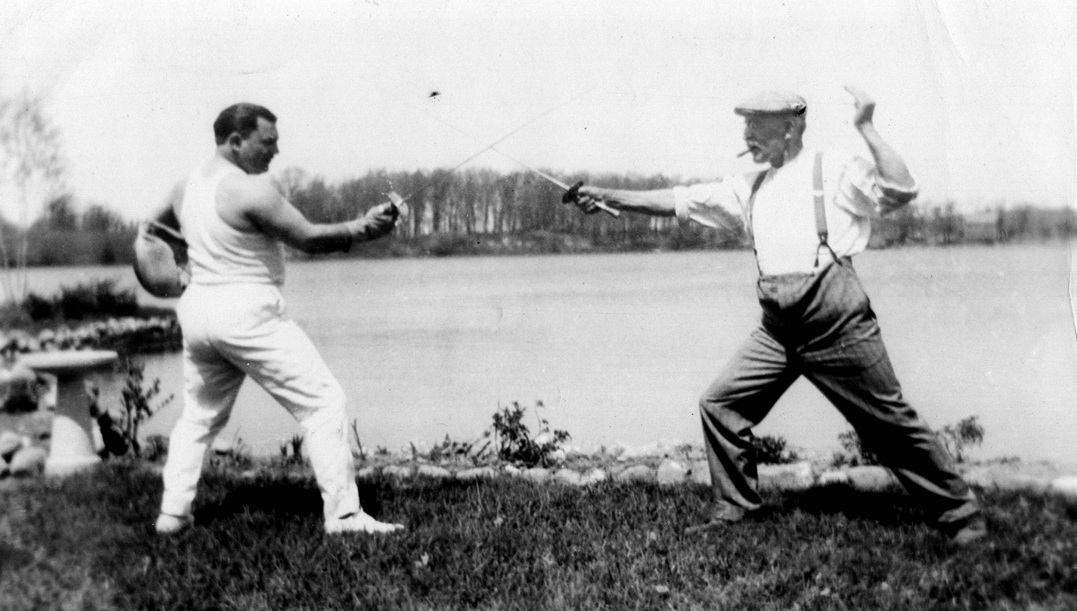
Stanley Maier in Two Theatrical Photographs
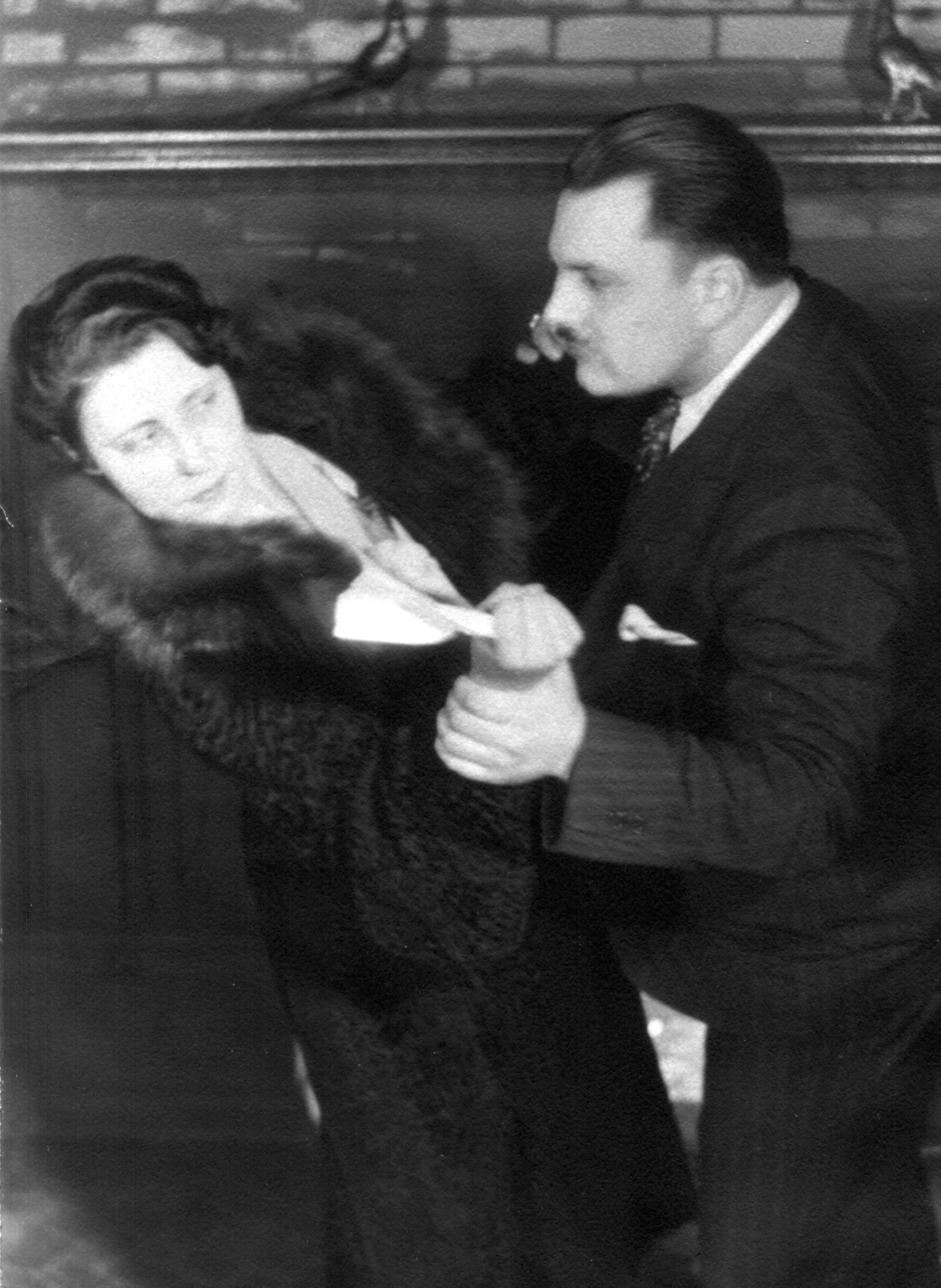
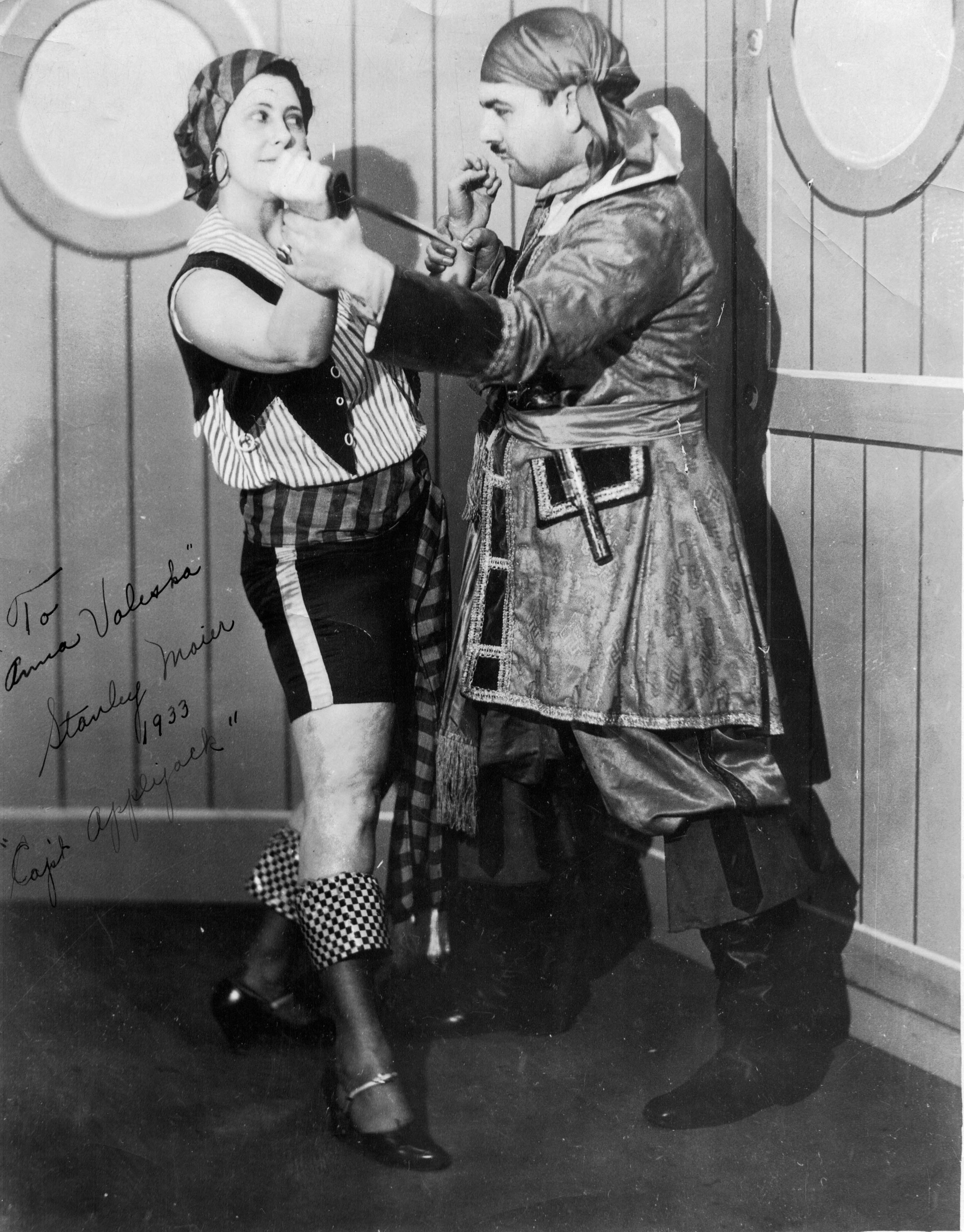
These two photographs show Stanley George Maier performing alongside actresses whose identities have not yet been established. They offer a glimpse of his involvement in theater, including an apparent leading role in a 1933 production of Captain Applejack, a play by Walter Hackett.
First Photograph: An Unidentified Dramatic Scene
In the first photograph, Stanley wears a suit and tie and has a full head of black hair. The woman beside him wears a fur coat and leans away from him as he grasps her left wrist. She appears to hold an object in her right hand, possibly a knife, although the object has not been positively identified.
This photograph may also depict a scene from Captain Applejack. The apparent confrontation would be consistent with the dramatic action of a mystery-adventure play. However, there is not enough evidence to confirm the production or identify the scene.
Second Photograph: Captain Applejack, 1933
The second photograph is dated 1933 and has been identified as showing a production of Captain Applejack. Stanley apparently portrays the title character, while the unidentified actress beside him portrays Anna Valeska. This suggests that Stanley held the leading role in the production.
The photograph appears to have been inscribed by Stanley for his fellow performer. Detroit Turners has been suggested as a possible venue, but that connection remains unverified. The actress’s identity and the location of the performance are still unknown.
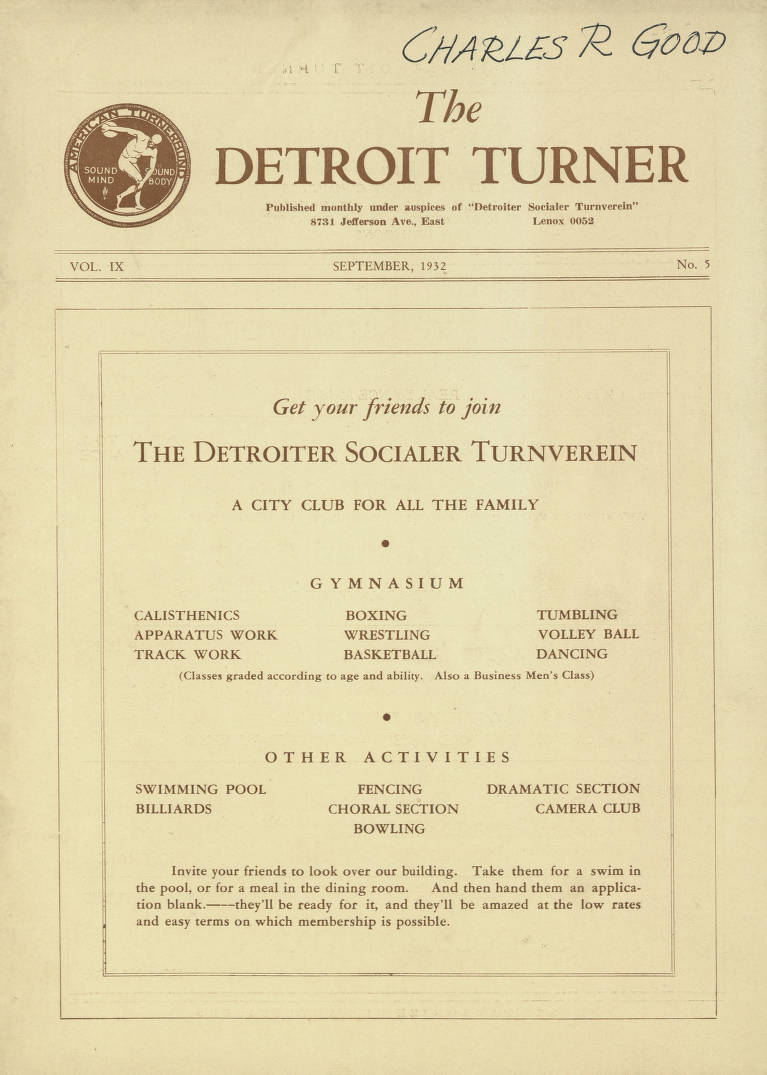
A Newsletter from the Detroit Turners