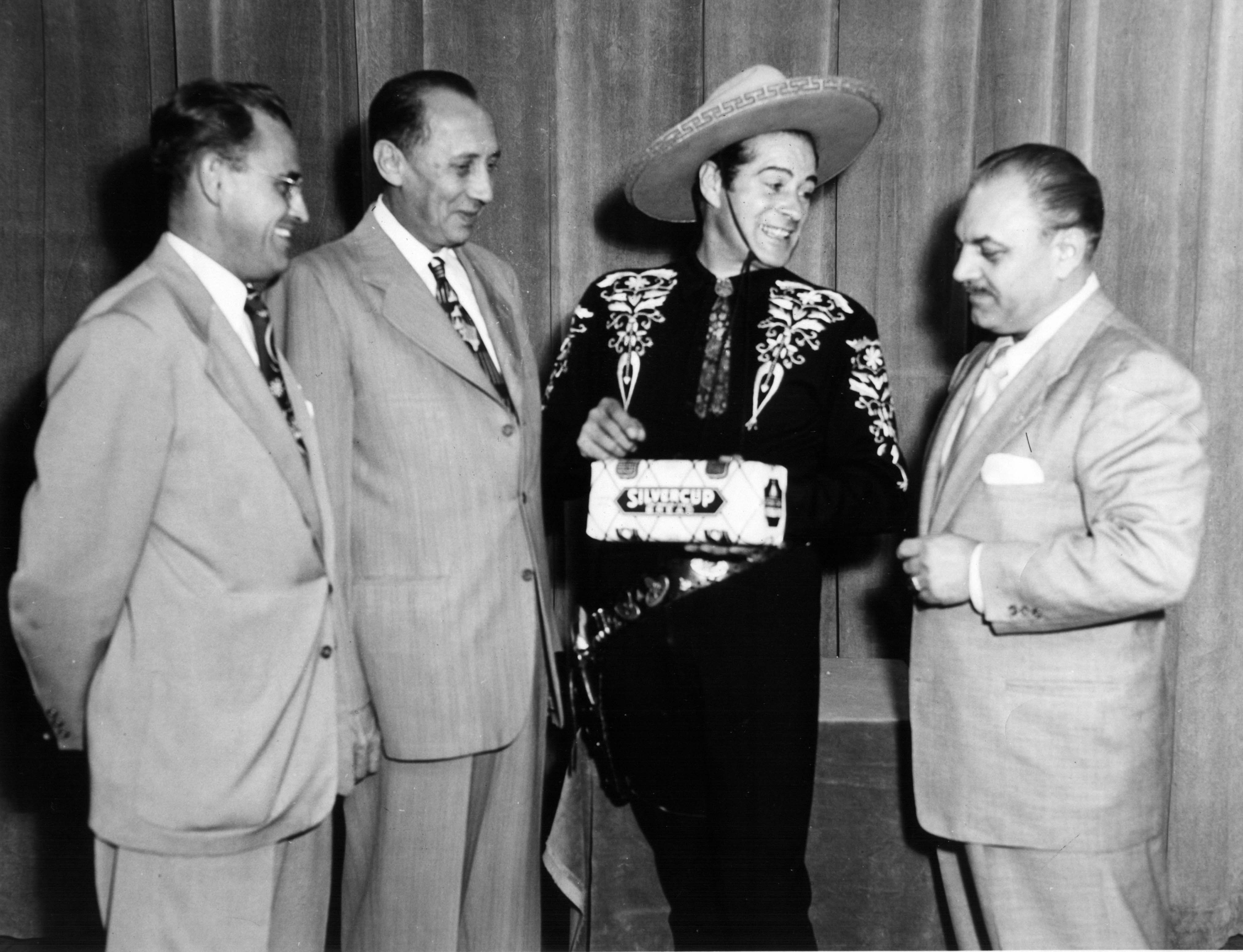
Stanley with Daugher Cathy's family in Florida, 1970
Cathy was Ernie’s younger sister. She was married to Robert “Bob” Orlando, who, like Cathy and Ernie, graduated from the University of Detroit in the early sixties.
Bob was an engineering graduate and had participated in ROTC as a student. Immediately after graduation, he began his long career in the Air Force.
Bob became a key part of the team that created and maintained the radar portion of the AWACS aircraft. AWACS stands for Airborne Warning and Control System.
The best-known version was the Boeing E-3 Sentry, a military aircraft based on the Boeing 707. The large circular disc mounted above the fuselage is a rotating radar dome, often called a rotodome.
AWACS aircraft were used to detect enemy aircraft and missiles at long distances, monitor airspace, and direct friendly fighter aircraft.
The program was in early development when Bob joined it. It became operational with the U.S. Air Force in 1977, during the Cold War.
Bob’s long career included many moves, with assignments in Ohio, Florida, California, Arizona, and Massachusetts.
Dad and my mother used to visit Cathy and her family often while Bob was stationed at Wright-Patterson Air Force Base in Ohio.
Wright-Patterson was essentially one of the Air Force’s principal centers for developing the next generation of military aircraft. It was not primarily a base for flying combat missions. It was where engineers, scientists, military officers, and defense contractors worked on the technology that would go into future aircraft.
ChatGPT discovered that important areas of work there included the AWACS airborne radar system, which we were just discussing, and the Foreign Technology Division, which studied Soviet and other foreign military technology.
Later, Bob was transferred to Eglin Air Force Base in Florida, where the work primarily involved testing and evaluating how aircraft and their equipment performed under operational conditions.
The picture of Stan was taken near Eglin Air Force Base.
Cathy and Bob were also stationed at Davis-Monthan Air Force Base in the Tucson, Arizona, area.
One year, Ernie and Jean and their three children made a great vacation trip to see Cathy and Bob and their children.
The essence of that trip will require another story.
Later, Cathy and Bob were transferred to San Pedro Hill Air Force Station. They lived in Palos Verdes, California, on a hillside overlooking the Pacific Ocean.
Ernie visited the family at some point while they lived there, likely as part of a business trip. He remembers being at their hillside home, but he does not remember the year.
Much later, Bob was transferred to Hanscom Air Force Base in Massachusetts. After retiring from the Air Force, he continued working as a contractor on that program until sometime during the first Trump presidency.
As Ernie recalls Bob’s explanation, Trump was unhappy with NATO funding, and the NATO countries increased their funding. That increase resulted in NATO taking over specific tasks and programs.
One winter, Bob contacted Ernie in Florida and asked whether Ernie’s longstanding offer to visit was still open.
Bob came to visit Jean and Ernie, and we all had a great week together. During that visit, Bob explained his abrupt retirement.
His boss had walked over to Bob’s desk and said that NATO was taking over his job. Whle his contracting job was still good this still seemed like a good time to retire.
As Ernie recalls, Bob said he thought about that for a while, then got up and began his retirement. That was why he was able to make the visit.
As of October 2026, Bob still lives in Chelmsford, Massachusetts.
Looking at the picture of Stan watering the flowers brought all these memories back to Ernie.
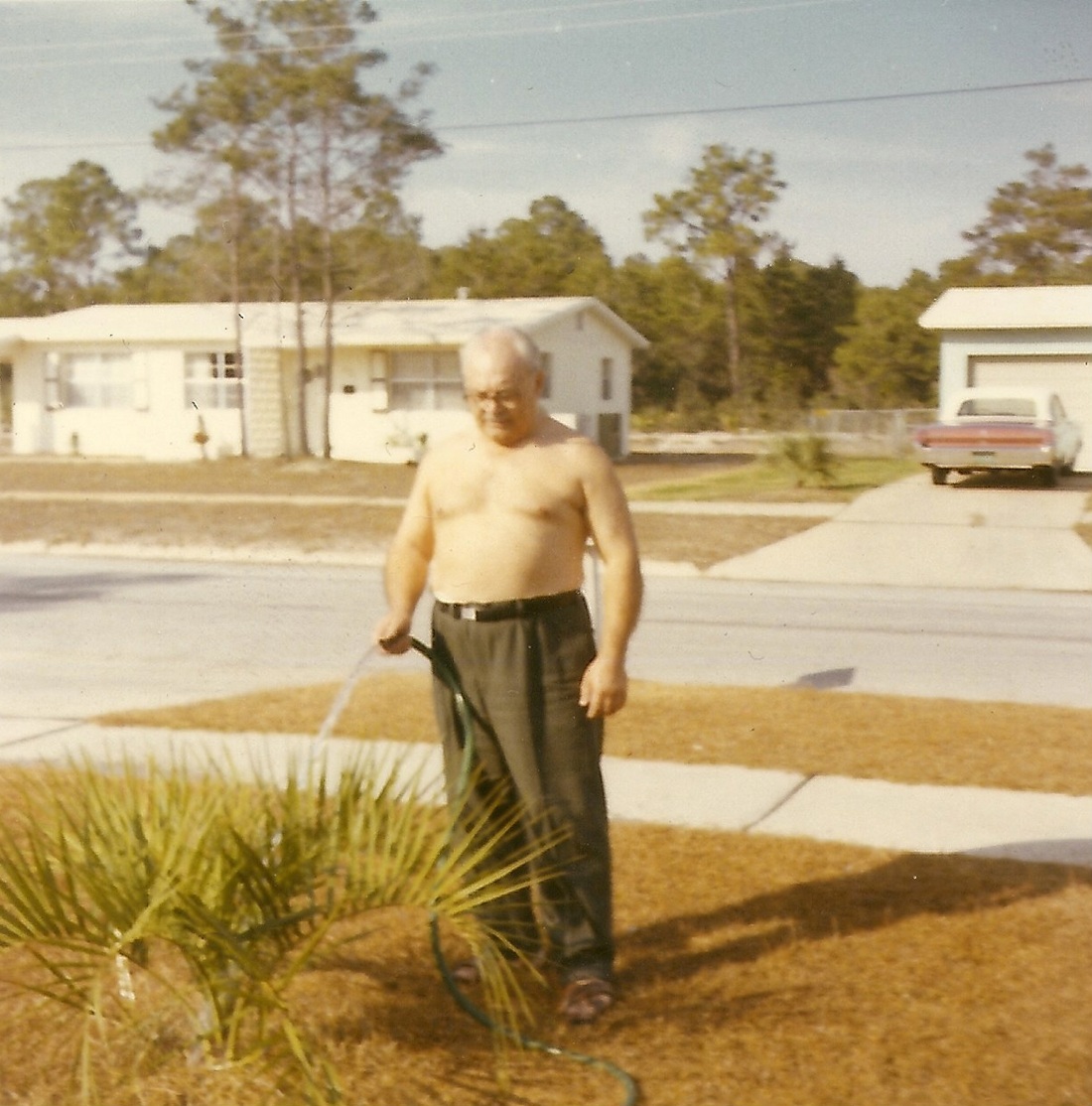
Stanley with Uncle Louis St. Aubin, 1970
When and where might this picture have been taken?
Seeing the gloves used to stop the lawn mower from moving, the orderly shelving in the background, and the shirt Stan is wearing leads me to believe it was taken in Stan’s garage at the family home at 4643 Balfour, on the east side of Detroit.
It could easily have been taken on Stan’s 66th birthday, August 21.
The family moved there about 1953. Ernie recalls having the car accident in Stan’s new 1954 Buick, and Stan being given the 1949 Lincoln shown in another picture in the yard at that house.
The house was still there in August 2026, although the garage was no longer there.
That August, Ernie had taken Audrey to Motor City Casino. Audrey was a neighbor who, with her husband, had helped Ernie at his house after Jean’s passing. During their outing, she asked about Ernie’s childhood.
They drove throughout the east side of Detroit, visiting St. Aubin Street, Turners, the high-rise where Dave had lived, and Wayne State University (WSU), including the Prentis Building, where Ernie’s office had been. They also visited both family homes and other places. Ernie could not identify the home on Lakeview, north of Warren, where he had lived with his family while teaching at WSU. Audrey took lots of pictures.
The house at 4198 Seminole was also still there. Ernie remembers living there from approximately 1945 to 1955, give or take a few years.
Stan wore gloves like those in the picture while working in his “man cave,” which was attached to the back of the garage. That space was likely originally plotted as an alley, but the alley had been abandoned.
The garage also makes sense as the location because Stan was 66, still maintained his yard, and always tried to get value out of his equipment.
It looks as though Uncle Louis had a brush in his hand and was cleaning a part he had removed.
Louis had his cigar—a trademark of his, as it was of my mother’s father and my mother’s nephew, Richard Werthmann, who was her sister’s son. I remember them smoking their cigars. I also remember the living room “side tables,” which had cutouts for smoky-colored ashtrays about six inches across.
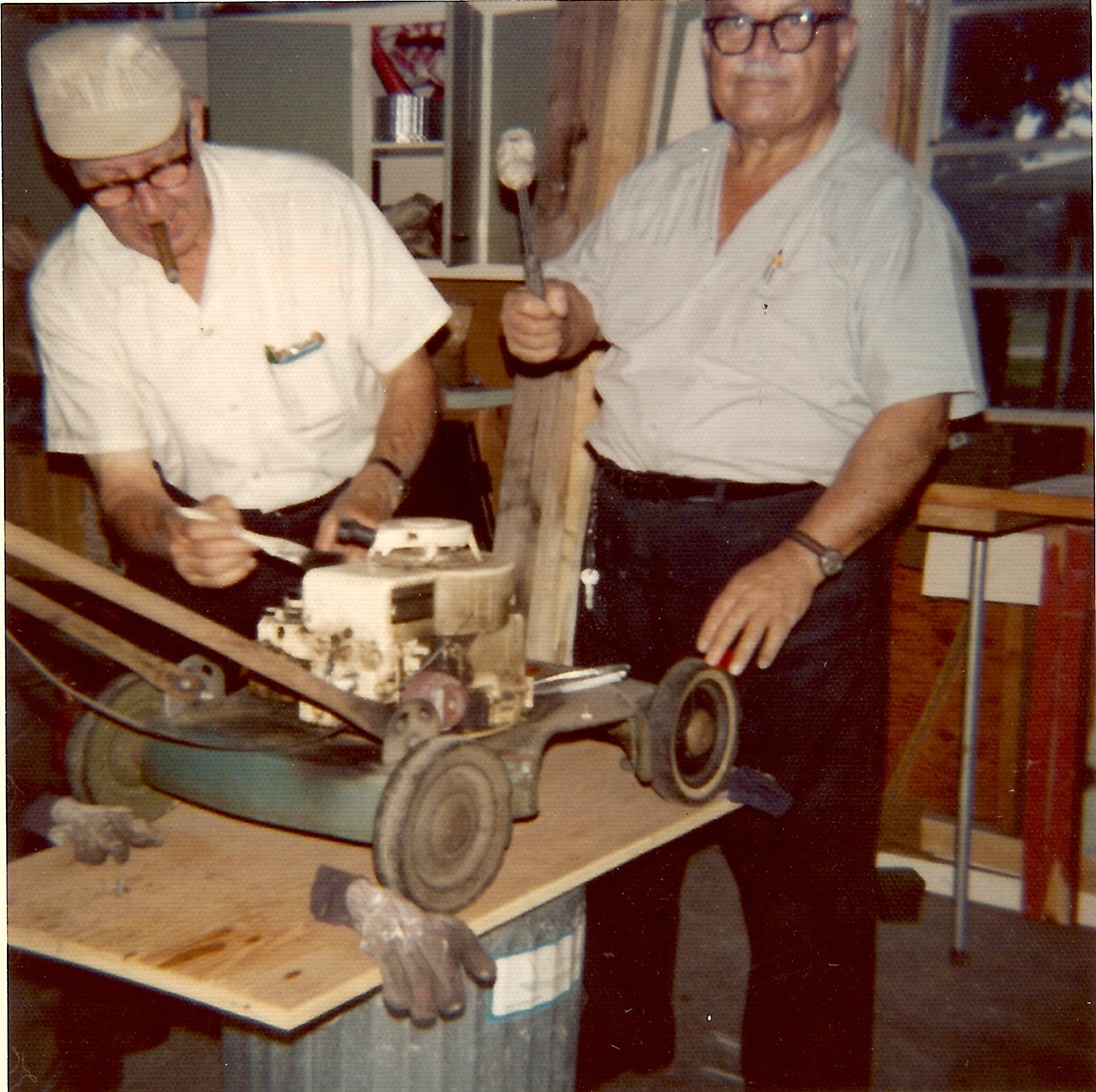
Stanley with Al LesPerance
What a really great picture—one of my favorites.
It was likely taken before my mother and dad were married, possibly several years before. I would guess sometime between 1924 and 1932.
From similar pictures, it seems my dad enjoyed being in plays, often as the leading man.
Al was either dating or married to Stan’s sister, Beaulah. Early on, Al and Stan were both bread truck drivers for Gordon Baking Co., the makers of Silvercup Bread.
The story was that Stan did something and got fired, and my Uncle Al helped him get his job back.
I recall several uncles and aunts, but I will save those memories for another time.
As you can read elsewhere, Stan eventually became vice president of Silvercup, just a few years before the company folded because it would not adapt to producing bread that could stay “fresh” on supermarket shelves for four to six days.
Several things in the picture caught my interest. Take a look at their similar shoes and socks—and their garters!
Yes, men wore garters to hold up their socks.
The belt closures also look familiar to me, and I believe they are still available today. They clamp the belt rather than piercing it, allowing you to adjust the fit to precisely where you want it.
The straw hat Al is holding is a style I’ll call the “boater hat.” It had a short revival around 1958. Seeing that hat reminded me of a summer job I had while in college.
The house in the picture caught my eye because it does not appear to be the back of the house on Fischer that I remember. That is another reason I suspect the picture dates to the late 1920s.
I have no idea why Stan had a whisk broom hanging by his crotch, what appears to be a strainer in his right hand, or why both men were holding flowers.
```
A Photograph of Stanley and Mildred Maier
This photograph is believed to show Stanley George Maier and his wife, Mildred Elizabeth Maier, dressed for a warm-weather social occasion. Their son, Ernest L. Maier, discussed the photograph and the family stories surrounding their two marriage ceremonies on October 10, 2026. The photograph’s location, occasion, and exact date remain unknown.
The working date estimate is approximately 1936–1938, with a broader possible range of 1934–1940. Preliminary observations suggested 1934–1939, particularly 1936–1937. These estimates are based on the clothing and automobiles described in the photograph and should not be treated as a confirmed date. Nothing establishes that the photograph was taken at either of their weddings.
The Clothing and Their Appearance
Mildred appears to wear a floral dress with a defined waist, a hemline between her knees and ankles, and a contrasting dark collar or front trim. Her large, asymmetrical hat has a brim that slopes noticeably downward on one side. She appears to wear stockings and light-colored, possibly white, summer pumps. She carries a coat over her arm and what appears to be a purse or light-colored handbag, although one accessory may instead be a folded item. These details were considered consistent with women’s fashions of approximately 1935–1939.
Stanley wears a dark, possibly black, sport coat with light trousers, a tie, pale or white shoes, and a pocket handkerchief. His light-colored hat has a fairly broad brim and a dark band. It appears to be a fedora, although whether it was felt or a lighter summer material cannot be determined. His long, roomy jacket and coordinated light trousers and shoes were considered consistent with 1930s warm-weather clothing.
Ernest was struck by Stanley’s fuller appearance compared with his appearance in the 1933 theatrical and fencing photographs. He also noted that Mildred appears slimmer than he remembers her during his childhood, while expressing some uncertainty about identifying her beneath the hat. Clothing and camera angle may affect apparent body size, so their appearance alone does not establish the photograph’s date.
The Automobiles and Setting
Rows of parked automobiles extend behind Mildred’s right arm and Stanley’s left arm. The earlier examination described at least three distinguishable cars behind Mildred, with additional vehicles farther along the drive. Their tall, relatively narrow passenger compartments, rounded roofs, upright rear windows, external bumpers, rear-mounted spare-tire arrangements, and large separate fenders were considered broadly consistent with American automobiles manufactured around 1933–1937.
Ford, Chevrolet, Plymouth, and Dodge produced similar body styles, but the photograph does not provide enough detail to identify individual makes or models reliably. Older vehicles also remained in use for years; a car manufactured in 1935 could readily appear in a photograph taken in 1939 or 1940.
The setting includes maintained grass, white-painted rocks forming a decorative border, and what appears to be a substantial parking area along a tree-lined drive. A partially visible building at the far right may be a residence, clubhouse, or outbuilding, but it cannot be identified. The clothing and grounds suggest a spring or summer gathering, possibly a wedding reception, private-club event, picnic, or another organized social occasion.
Ernest did not recognize the building. Although the painted rocks reminded him of decorative borders at the family cottage, he felt that the grounds and extensive parking area did not match that property. The location therefore remains unidentified.
The First Wedding: An Elopement to New York
Ernest recalled that his parents had two marriage ceremonies, although he could not provide their wedding dates at the time of the discussion. According to family accounts, they first eloped from Detroit to New York. He initially suggested downtown Manhattan, then considered Long Island more likely because a bread plant associated with Stanley’s work was located there. The actual location has not been established.
The explanation Ernest remembered involved difficulties bringing the two families together and arranging a wedding in Detroit, rather than a disagreement between Stanley and Mildred. Stanley’s family was German, while Mildred’s family was primarily French. Family stories suggested that these cultural backgrounds, possibly influenced by tensions before World War II, complicated the arrangements.
Ernest could not verify that explanation. His reference to 1939 was hypothetical, not a known wedding date. The reason for the elopement remains a family recollection rather than an established historical fact.
The Second Wedding: A Church Ceremony in Detroit
The couple later had a church marriage ceremony, but its date and location remain unknown. Ernest suggested St. Anne’s Church because of its French history, or St. Catherine’s in the neighborhood where his grandmother lived on Fisher. He recalled a possible intersection involving Seminole and Canfield, then reconsidered whether it was Sylvester and Seminole. These church and street references require verification.
Ernest also did not know where Stanley lived before his marriage or whether he lived near that neighborhood. A marriage certificate or church record may help establish the dates and locations of the ceremonies.
According to the story Ernest heard, Stanley had not previously been a regular churchgoer and had attended relatively few weddings. During Ernest’s childhood, however, Stanley did attend church, possibly encouraged by Mildred and perhaps also through his own faith. Ernest emphasized that he did not intend this recollection as a negative judgment of his father’s religious beliefs.
An Unexpected Departure After the Ceremony
One especially memorable family story concerns the end of the church wedding. Stanley apparently drove to the church, parked on a side street, and entered through a side door. After the ceremony, he asked the priest, “What do I do now?” Ernest believed that Mildred herself may have told him this story.
The priest reportedly gave a general response indicating that the ceremony was over and the couple could leave. Taking that instruction literally, Stanley escorted Mildred out through the side door, returned to his car, and drove away—leaving the other guests in the church wondering what had happened.
Ernest regarded this as a particularly believable and amusing family memory. He also noted a parallel with his own previously recorded account of how he got married on his wife’s wedding day. These stories preserve the family’s recollections, while the photograph’s estimated date, the wedding locations, and the reasons for eloping remain unconfirmed.
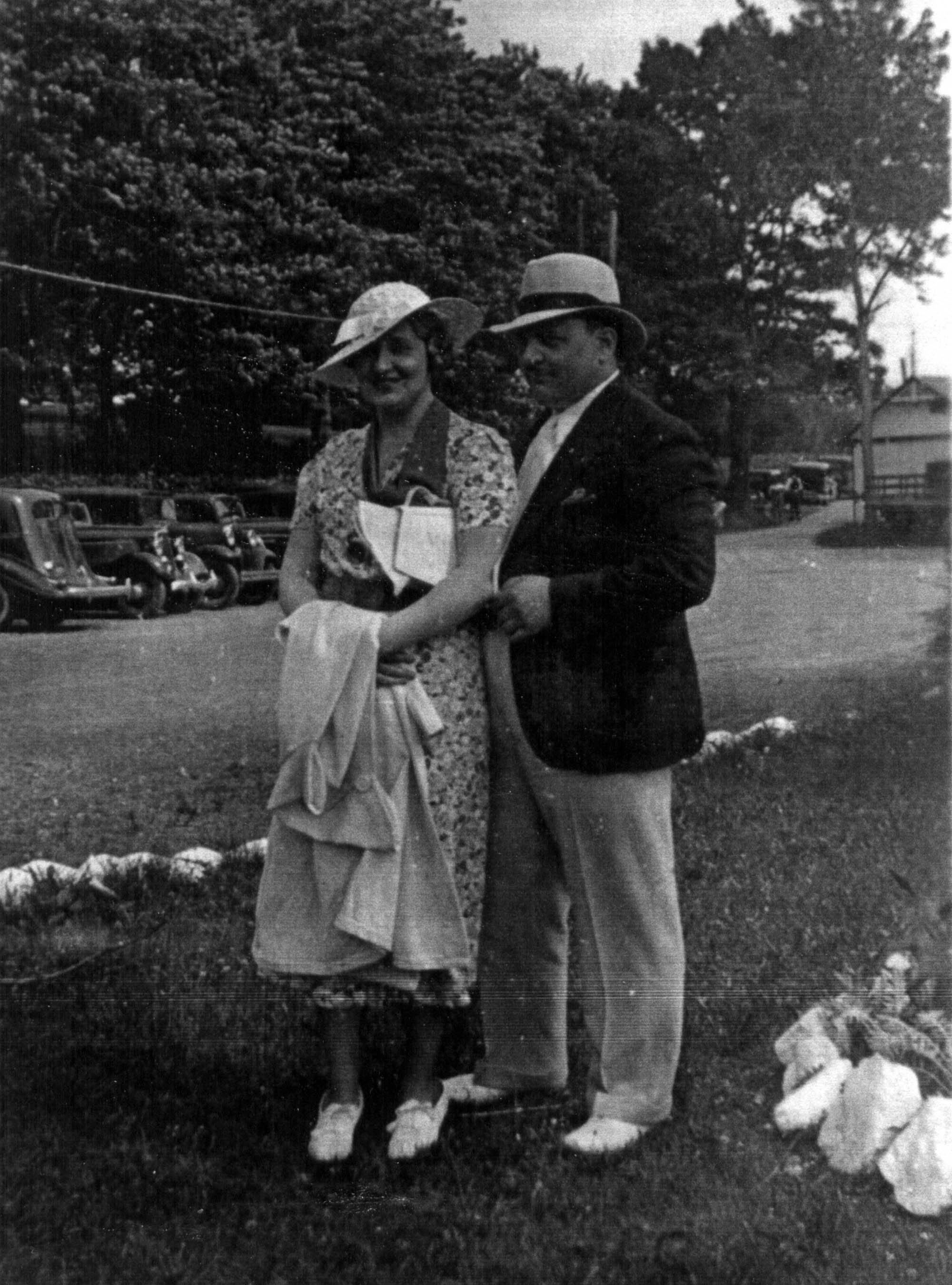
My First Remembered Home — Woodside, New York, Spring 1944
This photograph shows my father, Stanley Maier, my sister, Cathie, and me, Ernest “Ernie” Maier, outside the first home I remember living in: 51-01 61st Street in Woodside, on Long Island, New York, in the borough of Queens. Based on the small flowers near my feet and our ages, I am confident that it was taken around spring 1944, give or take about two months. Cathie would have been approximately three years old, and I would have been about five and a half.
The photograph was taken near the front of our home, at the end of a long row of attached houses. Our end unit had windows on three sides, while the interior units had windows only at the front and back. I believe that the extra windows were one reason my parents chose that house. I also believe my father bought it, although I cannot say with certainty whether we owned or rented it.
The front of the house was on relatively level ground, with perhaps one or two steps leading onto a small porch. The white picket fence visible in the photograph extended toward the backyard. I remember playing in the backyard rather than in the area where we are standing.
Details in the Photograph
One detail that helps me recognize myself is my hairstyle. My hair was parted over my right ear, a style I continued wearing until fairly recently, when I began combing it back as my father did. My hair was curly then and still curls when it grows longer.
My father is wearing a wristwatch on his left wrist and a belt. His rounded build reminds me of another photograph of him with my mother that we discussed previously. The bricks visible at the lower right of this photograph suggest that my parents were beginning to do some gardening around the house.
The Backyard and a Childhood Accident
I remember the area where I played in our backyard as flat, although the surrounding ground stepped or sloped down toward the properties behind us. There was a barrier separating the yards on our street from those of the houses beyond them, where the ground was lower. At first, I remembered the difference in height as eight or ten feet, but on reflection it was probably closer to four feet.
That drop is memorable because I once fell from it and broke my arm. I wore a cast for some time afterward.
My Father’s Work at the Silvercup Bakery
While we lived in Woodside, my father was the plant manager of the Silver Cup Bakery, part of the Gordon Baking Company, on Long Island. The former bakery building later became Silvercup Studios, a television and motion-picture production facility.
The original studio location is at 42-22 22nd Street, Long Island City, New York 11101. This is the former bakery site associated with my father’s work, rather than one of the company’s newer studio facilities. The transcript identifies 1983 as the year Silvercup Studios opened in the former bakery.
Wartime Life: A Victory Garden and Blackouts
We lived in this house during World War II. Across the street, my father maintained a substantial victory garden, which he fenced using fallen trees. It may have been a community garden, but I do not remember anyone else working there. I do remember going over and helping with whatever tasks I was given.
At night, we observed wartime blackouts. No light was supposed to escape from the house. People patrolled the neighborhood, and if they saw light coming from a home, they notified the occupants, who had to block it. I remember these precautions as being connected to concern about German submarines in the New York harbor area.
I have looked at the neighborhood online in later years and believe buildings now occupy the area across the street where the garden stood, although I do not have a clear recollection of what is there today.
Kindergarten Memories and Our Return to Detroit
I remember attending kindergarten while we lived in Woodside. We played with wooden blocks and afterward put them away in a box in the corner. Another activity involved what I remember as “green numbers”: a set of numbers that we arranged on our desks in order from one to one hundred. I cannot remember whether the numbers came in an envelope or another kind of container, and I remember little else about school there.
I do not know exactly when my parents moved to Woodside or how long we lived in the house before this photograph was taken. After we returned to Detroit, I attended St. Catherine’s Elementary School, across from 4198 Seminole. I may have finished kindergarten there or begun first grade; I am not certain which.
When I looked up the property several years ago, I recalled its estimated value as roughly $800,000 to $1 million.
This photograph preserves more than the appearance of our family and our house. It brings back memories of my father’s work, our backyard, kindergarten, the victory garden, and everyday life during World War II.
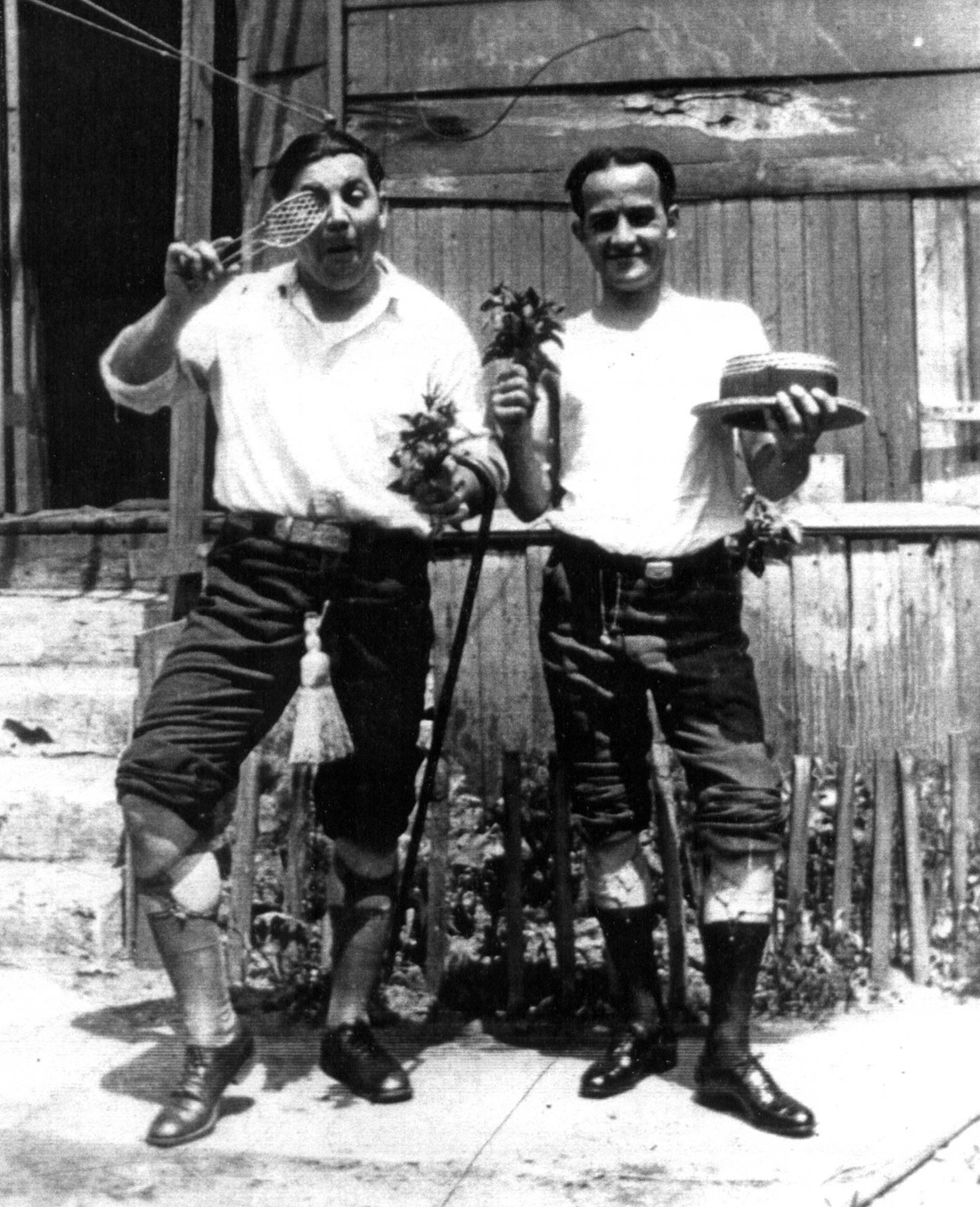
Stanley Maier with the Cisco Kid — Silvercup Bread, Circa 1951
This photograph shows four people associated with what appears to be a promotional occasion involving Gordon Baking Company and its Silvercup Bread brand. Stanley George Maier stands on the far right. Immediately to his left, second from the right, is the man identified by his son, Ernie, as the Cisco Kid. The two people on the left remain unidentified. Ernie does not recall seeing either of them elsewhere and states that neither was John Cooper, president of Gordon Baking Company during that period.
The photograph is provisionally dated to approximately 1951. Research recorded in the accompanying transcript cites the February 3, 1951, issue of Billboard as documenting Gordon Baking Company’s sponsorship of The Cisco Kid television series. That sponsorship provides a reasonable basis for estimating the photograph’s date, although the photograph itself has not been independently dated and the full sponsorship period has not been established.
Stanley’s Role at Gordon Baking Company
According to Ernie’s recollection, Stanley handled responsibilities that would now likely fall within a marketing or advertising department, although his formal title may have been Sales Manager. His appearance with the Cisco Kid appears consistent with his involvement in promoting the company and its Silvercup Bread brand.
Stanley eventually became a vice president. Ernie recalls that a letter documenting that appointment is stored in a box in the room currently used as a storage bedroom.
The transcript also records an earlier connection between Silvercup Bread and popular entertainment: Gordon Baking Company sponsored The Lone Ranger radio program from November 27, 1933, through March 1939, beginning with Detroit station WXYZ. That earlier radio sponsorship was separate from the company’s later sponsorship of The Cisco Kid on television. Stanley's grandchild David recalls having a pistol holster that his grandfather gave him and wishes he still had it. It may have come from the long ranger through his grandfather and, if not, was his grandfathers.